Categorie: Uncategorized

  • Jan Timman and Jorden van Foreest play a match in the Hoogeveen Tournament

    Jan Timman and Jorden van Foreest play a match in the Hoogeveen Tournament

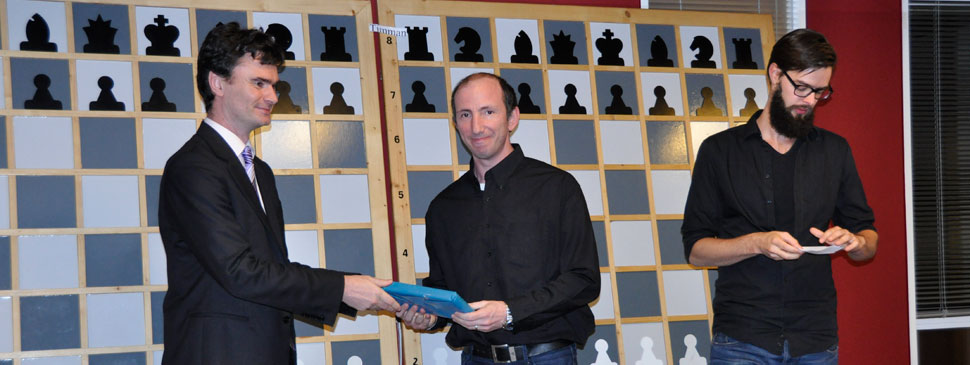
    The main attraction of the chess tournament in Hoogeveen this year is a match between Jan Timman and Jorden van Foreest. The laurelled top grandmaster and the up-and-coming talent play six games between October 17 and 24 in the town hall of Hoogeveen. Negotiations for a second match are being made at this point. For the 19th time, a large open tournament and two amateur tournaments will also be held in Hoogeveen. A new feature this year is a Basque tournament on Wednesday 21th October.
     
    Among the participants in the open tournament will be the Dutch top players Erwin l’Ami, Sipke Ernst and Jan Werle. They will cross swords with a choice of Dutch and foreign players. The amateur tournaments will be played over seven rounds and have a rest day on Wednesday 21th October. 
     
    The Basque tournament is a form of chess that was first introduced in the Basque city of San Sebastian: with each duel the opponents play each other on two boards simultaneously, once with white and once with black. It is a new branch on the evergreen tree of chess.
     
    The event is organized for the second time with grandmaster and multiple Dutch champion Loek van Wely in the function of tournament director. The most important sponsors of the Hoogeveen Chess Tournament are the municipality of Hoogeveen, the province of Drenthe, McDonald’s and UnivĂ©.

  • Basque Chess on October 21

    Basque Chess on October 21

    A new feature this year is a Basque tournament on the rest day, Wednesday 21th October: a form of chess that originated in the Basque city of San Sebastian: with each duel the opponents play each other on two boards simultaneously, once with white and once with black. This is a new branch on the evergreen tree of chess.

    Information:
    Entry fee: €15
    Prize fund: €500 
    Maximum number of participants: 32

    Rate of play: 25 minutes, + 20 seconds per move
    Number of rounds: 5, with 2 games per round

    1st round 10.00 uur, final round 17.00 uur

    Registration

  • Giri en Jobava slaan nog eenmaal toe

    Giri en Jobava slaan nog eenmaal toe

    In de laatste matchpartijen hebben beide verliezers nog eens gevoelige klappen opgelopen. Jan Timman was andermaal niet opgewassen tegen het experimentele spel van Baadur Jobava, en Alexey Shirov was opnieuw “geplugd”.
     
    Giri – Shirov
     
    1.e4 c5 2.Pf3 Pc6 3.d4 cxd4 4.Pxd4 Pf6 5.Pc3 e5 6.Pdb5 d6 7.Lg5 a6 8.Pa3 b5 9.Pd5 Le7 10.Lxf6 Lxf6 11.c3 Lg5 12.Pc2 0–0
    Deze zet wordt tegenwoordig meestal vermeden en vervangen door 12…Tb8, en Giri toont in deze partij aan waarom.
    13.a4 bxa4 14.Txa4 a5 15.Lc4 Tb8 16.b3 Kh8 17.Pce3 g6 18.h4 Lxh4 19.g3 Lg5 20.f4 exf4 21.gxf4 Lh4+
     

    22.Kf1
    22.Kd2 was de meer gebruikelijke zet, maar Giri had gevonden dat de tekstzet zwart voor flinke problemen stelt.
    22…f5 23.Ta2 fxe4 24.Tah2 g5 25.Dh5
    Blijkbaar de meest cruciale. In de stampartij van 22.Kf1, Hracek-Mista, TsjechiĂ« 2006, volgde 25.Pg2 Tb7 26.Pxh4 gxh4 27.Txh4 Tg7 28.Dh5 Lf5. In een latere partij deed zwart 28…Le6 en werd het meteen remise na 29.Dxh7+.
    25…Tb7
    In een partij Barski-Skliarov (2013) volgde 25…Pe5 26.Ke2 Pxc4 27.fxg5 Txb3 28.Txh4 Tb2+ 29.Ke1 Tb1+ 30.Pd1 Lf5 31.g6 Tb7 en nu won wit een stuk met 32.De2 Lxg6 33.Dxc4 en wit kon dit niet winnen, “maar dit ziet er niet goed uit”, vond Shirov.
    26.Ke2 Le6 27.Dh6 Lg8?!
    Te passief. De beste kans lijkt nog 27…Lxd5 28.Pxd5 Tff7 (deze verdediging had Shirov overzien) maar na 29.De6 blijft wit aan het roer.
    28.Tg2
    Tot hier had Giri gerekend. Het alternatief is 28.Tg1, beide zetten zijn kansrijk.
    28…Tbf7
    Hierna stort de zwarte stelling in. De computer geeft nog 28…Pe5 29.fxe5 dxe5 30.Txh4 gxh4 31.Dh5 Te8 maar dat ziet er niet bepaald aantrekkelijk uit.
     

    29.Txh4! gxh4 30.Pf5
    Ook 30.f5 wint, met de dreiging 30.f6 en 31.Dg7+. Zwart kan niet op f6 slaan omdat de loper op g8 hangt. 30…h3 31.Tg5 en wit wint.
    30…h3 31.Ph4 Dxh4 32.Txg8+ Txg8 33.Dxh4
    En Shirov spartelde nog een tijd, maar de vis werd uiteindelijk op het droge gebracht. 
     
    Jobava – Timman
     
    1.c4 e5 2.Pc3 Pf6 3.Pf3 Pc6 4.g3 Lc5 5.Lg2 d6 6.d3 h6 7.a3 a6 8.b4 La7 9.0–0 0–0 10.Le3!?
    De eerste aparte zet van Jobava van vandaag, al eerder gespeeld door onder anderen Daniel Fridman. “Een verleidelijke zet voor mij”, zei Jobava. “De sterke loper op a7 gaat eraf en de pionnenstructuur wordt veranderd.”
    10…Lxe3
    De principiĂ«le zet. Anderen hebben 10…Pd4 gespeeld.
    11.fxe3 Le6 12.Ph4 Pg4
    12…Tb8 vond Jobava beter. “Dan speel ik 13.Dd2 en gaat het langzaam verder.”
    13.Dc1 Dg5
    Deze zet vond Jobava ook minder. Het alternatief was 13…f5 Wit wint dan een pion met 14.h3 Pf6 15.Pxf5 maar zwart krijgt wat tegenspel met 15…Dd7 16.g4 h5 Jobava: “Nu kan ik zijn structuur vernielen.”
    14.Lxc6 bxc6 15.e4 Dh5!?
    Volgens de Georgiër moesten de dames geruild worden.
    16.h3 Pf6 17.Kg2
     

    Nu wil wit opstomen op de damevleugel met a3–a4–a5 en b4–b5. Daarom onderneemt Timman actie:
    17…d5 18.cxd5 cxd5
    Maar daarvoor staan de zwarte stukken verkeerd:
    19.Txf6! gxf6 20.exd5 Ld7 21.De3
    “Misschien was 21.e4 nog wat beter”, zei Jobava. “Maar ik was er niet zeker van, dus koos ik voor een meer geforceerde variant.”
    21…Dg5 22.Dc5 f5 23.Dxc7 Tad8
    23…Tac8 24.Dxd7 Txc3 25.Pxf5 Tc2 26.Te1 is ook geen probleem voor wit.
    24.Pf3 Dh5 25.Pxe5 Lb5 26.Pc4 Tfe8 27.Tf1


    27…Td7
    27…Tc8 was volgens Jobava nog een wat betere versie, bijvoorbeeld 28.Df4 Txe2+ 29.Pxe2 Dxe2+ 30.Tf2 Dxd3 31.Pe3 De4+ met goede winstkansen voor wit in het eindspel.
    28.Df4 Txe2+ 29.Pxe2 Dxe2+ 30.Tf2 Dxd3 31.Pe3 Te7
    Bij afruil met 31…De4+ zou de toren op d7 passiever staan dan op c8.
    32.Pxf5 Dxd5+ 33.Kh2 Td7 34.Dg4+
    En opgegeven wegens mat.
     
    Een keihard einde voor beide wereldspelers Alexey Shirov en Jan Timman, maar wel helemaal in de lijn met wat zich hier deze week heeft afgespeeld. Wij hebben genoten van elke minuut, en wij hopen u ook!

  • Respect

    Respect

    Tex de Wit, a comedian and a chess commentator, presented the closing ceremony smoothly. His first ‘guest’ was alderman Gert Vos of Hoogeveen, who had been impressed throughout the week by the ‘noble spirit’ of chess: ‘I’ve played soccer and volleyball, but there’s always noise there. A chess tournament has a respectful, concentrated atmosphere.’

    He called it a great honour to host this chess event in the Hoogeveen town hall, and said that, as far as he knew, the tournament would be welcome again next year. Then he asked for a round of applause for the tournament secretary, the very versatile Jeroen Bottema, and for the new tournament director Loek van Wely, who had done a great job in his opinion: ‘I’ve seen nothing but satisfied faces here.’
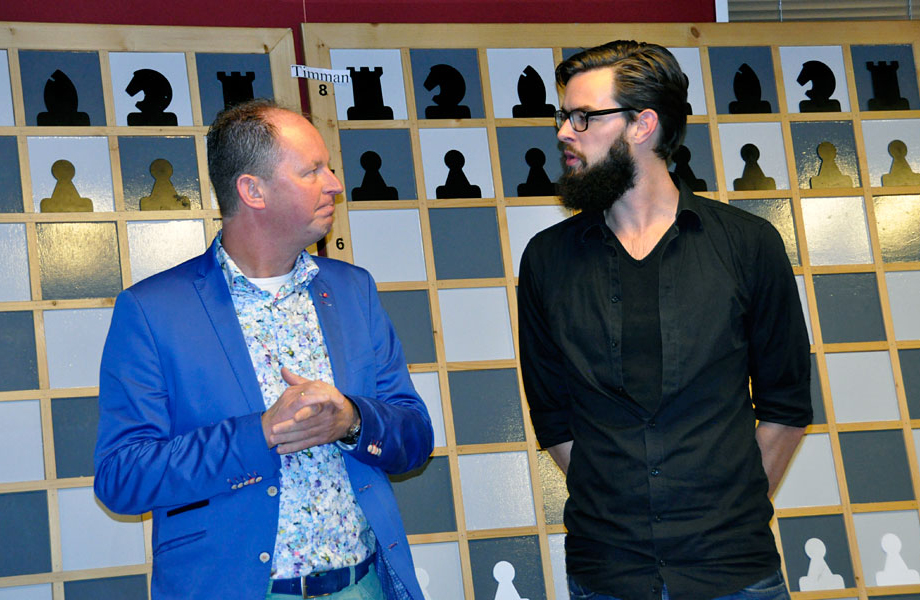

    Gert Vos | Photo: Peter Doggers

    The tournament treasurer, Teun Boersma, addressed Loek van Wely especially: ‘You’ve made something very special of this event, and I am convinced that you will become a good “horseman”.’ Then he presented the ruling Dutch champion with a beautiful book called ‘The Beauty of the Horse’.

    ​To the question repeated by Tex de Wit, what was actually worse: losing a tournament or leading one, Van Wely still didn’t give a clear-cut answer: ‘I haven’t really been myself this week
 next week I’ll be a player again, and chess gives me less stress for sure. Do I have more respect for organizers now? Well, I may have been nasty to some of them in the past
 now I’ll think again before I do that.’ In any case many people have come to respect the leading capabilities of the top chess player from Tilburg.
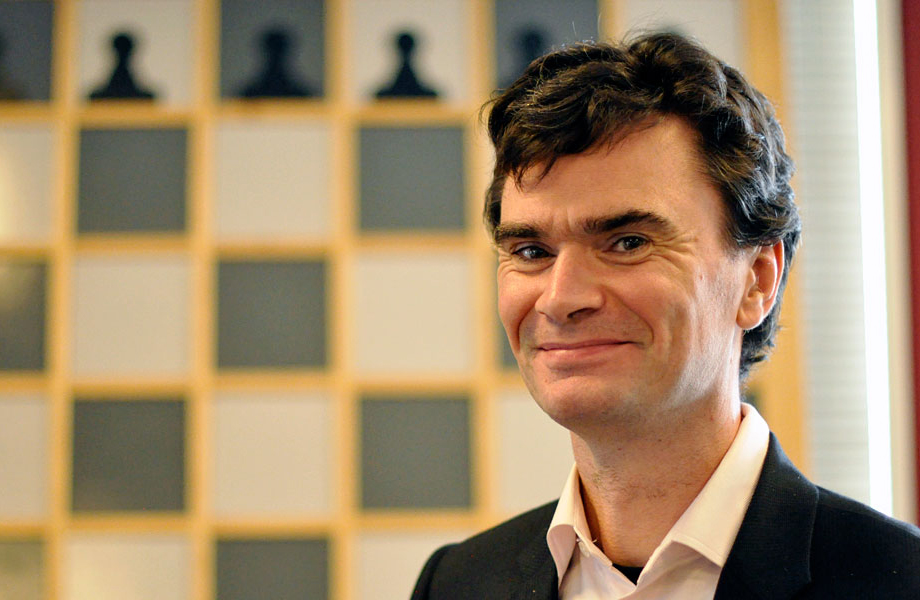

    Loek van Wely | Photo: Peter Doggers
     
    The Prize Giving
    Wouter Slump got a prize for the best performance in Nick Maatman’s simultaneous display at McDonald’s. In Amateur Group 2 (the morning group), Tinus Fleur was the champion. A few decades ago he’d had a winning position against Loek van Wely in the town of Gorredijk. Had he converted that position, who knows he might have been standing on the stage in another capacity today. The main prize in Amateur Group 1 (afternoon) went to Johan Mostertman.

    Van Wely said that he thought the new set-up of the tournament, with two matches instead of a four-player double round robin, was a success: ‘We had four great fighters. I was hoping for many decisions, and uncompromising play, and I am happy. Only Baadur Jobava let me down: he played a few “normal” games here. That wasn’t the deal.”

    Jan Timman was of course disappointed with his result, but he said he had enjoyed playing such an interesting opponent. When Jobava was asked whether he was happy, he simply said: ‘Yes!’
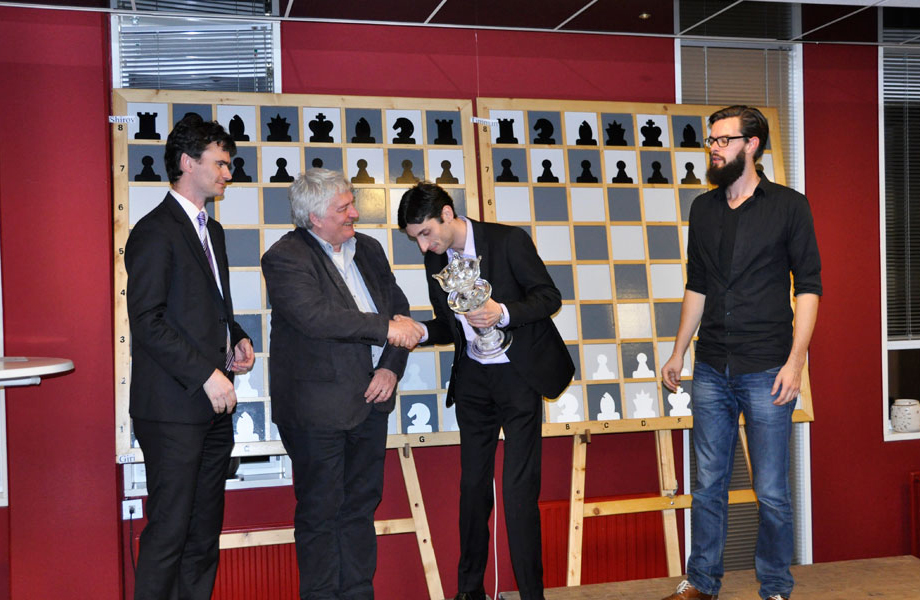

    Jobava thanks Timman | Photo: Peter Doggers

    De Wit, who is a fan of Shirov’s Fire on Board books, asked the author if we could expect a third volume soon. ‘Maybe’, Shirov answered, still a little shaken. ‘But then the title may be “Smoke after Fire…”

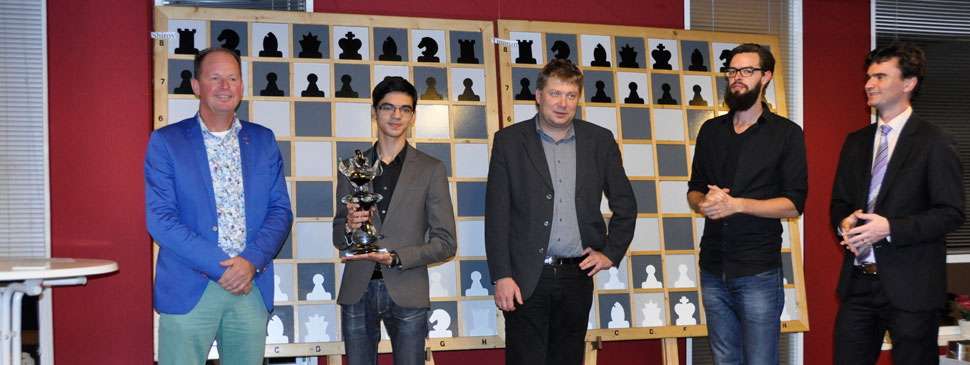
    Like Baadur Jobava, Anish Giri was about to travel to Tashkent to play the Grand Prix tournament. ‘Here things worked out well, let’s see if they also work out well there. I may be one of the favourites now, but I still have the feeling that my rating is a bit too high.’ We’ll see in the coming days.
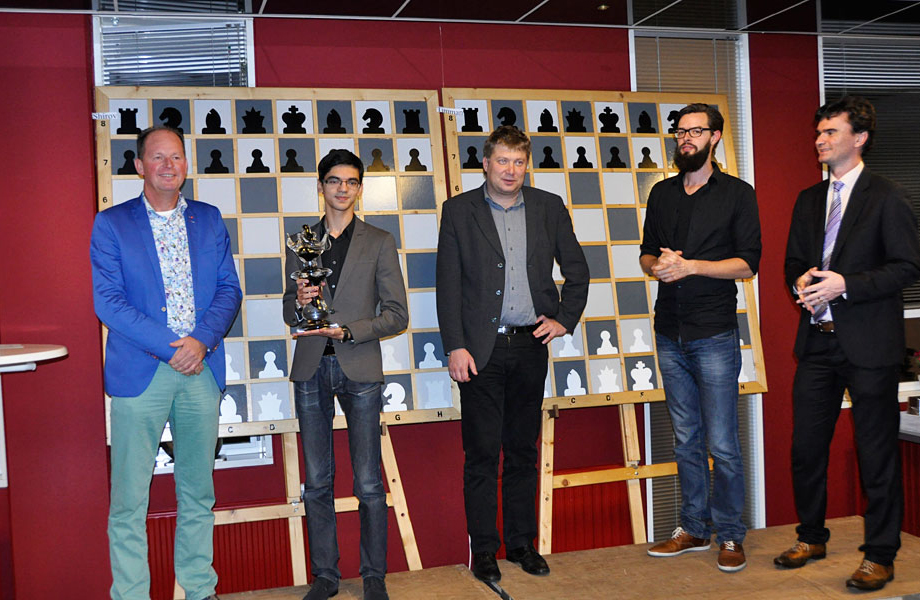

    Anish Giri with his trophy | Photo: Peter Doggers

    Finally Van Wely handed a prize to Mees van Osch, who had achieved his first IM-norm in the Open. And so there were many satisfied faces, Saturday night in Hoogeveen.

    Many thanks to everyone involved in the tournament, and hopefully till next year!

  • Respect

    Respect

    Stand-up comedian en schaakcommentator Tex de Wit praatte de slotceremonie met veel vaart aan elkaar. Zijn eerste ‘gast’ was wethouder Gert Vos van Hoogeveen, die de afgelopen week onder de indruk was geraakt van de ‘nobele geest’ van de schaaksport: “Ik heb wel voetbal en volleybal gespeeld, daarbij is het altijd lawaaierig. Hier heerst een respectvolle, geconcentreerde sfeer.”

    Hij noemde het een grote eer om dit schaakevenement in het raadhuis te mogen herbergen en zei te verwachten dat het toernooi ook in 2015 weer welkom zal zijn. Daarna vroeg hij een applaus voor toernooisecretaris en allesdoener Jeroen Bottema, en voor de nieuwe toernooidirecteur Loek van Wely, die een ‘geweldige job’ had gedaan: “Ik heb alleen maar tevreden gezichten gezien deze week.”


    Gert Vos | Photo: Peter Doggers

    Penningmeester Teun Boersma richtte een speciaal woord tot Loek van Wely: “Je hebt er iets heel bijzonders van gemaakt en ik ben ervan overtuigd dat je een goede ‘ruiter’ wordt.” En hij bood de regerend Nederlands kampioen een fraai boek genaamd ‘De Schoonheid van het Paard’ aan.

    Op de herhalingsvraag van Tex de Wit wat nu eigenlijk erger was: onderaan eindigen in een toernooi of een toernooi leiden, hield Van Wely het nog steeds in het midden: “Ik was deze week niet echt mezelf… volgende week ben ik een speler, en schaken geeft mij zeker minder stress. Of ik meer respect heb gekregen voor organisatoren? Nou, ik ben misschien wel eens gemeen tegen sommige geweest… ik zal nu eerder tot tien tellen voor ik dat doe.” In ieder geval hebben velen deze week respect gekregen voor de leidinggevende capaciteiten van de topschaker uit Tilburg.


    Loek van Wely | Foto: Peter Doggers
     
    De prijsuitreiking
    Wouter Slump kreeg een prijs voor de beste prestatie in de McDonald’s-simultaan door Nick Maatman. In Amateurgroep 2 (de ochtendgroep) werd Tinus Fleur kampioen. Die had enkele decennia geleden nog eens een gewonnen stelling gehad tegen Loek van Wely in Gorredijk. Had hij die gewonnen stelling ook verzilverd, dan had hij hier vandaag misschien in een andere hoedanigheid op het podium gestaan. De hoofdprijs in Amateurgroep 1 (middag) ging naar Johan Mostertman.

    Van Wely gaf aan dat hij de nieuwe opzet van het toernooi, met twee matches in plaats van een vierkamp, geslaagd achtte: “We hadden vier geweldige vechters. Ik hoopte op veel besliste partijen en compromisloos spel, en ze hebben me niet teleurgesteld. Alleen Baadur Jobava, die heeft hier een paar ‘normale’ partijen gespeeld. Dat hadden we niet afgesproken.”
    Jan Timman was natuurlijk teleurgesteld met zijn resultaat, maar zei dat hij het mooi had gevonden tegen zo’n interessante speler uit te komen. Op de vraag aan Jobava of hij ‘happy’ was, zei deze simpelweg: “Yes!”


    Jobava bedankt Timman | Foto: Peter Doggers

    De Wit, een fan van Shirov’s Fire on Board boeken, vroeg de auteur of we binnenkort een derde deel konden verwachten. “Misschien”, reageerde deze, nog steeds een beetje aangeslagen. “Maar dan gaat het waarschijnlijk ‘Smoke after Fire’ heten…”
    Anish Giri stond, evenals Baadur Jobava, klaar om naar het Grand Prix-toernooi in Tashkent af te reizen: “Het ging hier heel goed, hopelijk kan ik dat daar vasthouden. Ja, ik word daar nu misschien tot de favorieten gerekend, maar ik heb nog steeds het gevoel dat mijn rating een beetje te hoog is.” Dat gaan we de komende dagen zien.


    Anish Giri kreeg zijn van Gert Vos uitgereikt | Foto: Peter Doggers

    Als laatste reikte Van Wely een prijs uit aan Mees van Osch, die in de Open groep zijn eerste meesternorm heeft behaald. En zo waren er vele tevreden gezichten, zaterdagavond in Hoogeveen.

    Alle betrokkenen bij het toernooi hartelijk bedankt, en hopelijk tot volgend jaar!

  • Mikhalevski wint Open

    Mikhalevski wint Open

    Na zijn zege op Beliavsky was Victor Mikhalevski constant bovenin te vinden. Maar voor de laatste ronde was hij slechts één van de drie koplopers. Toen zijn maat Michael Roiz snel remiseerde met Beliavsky was de buit bijna binnen, want ook Mikhalevski won snel van Sopiko Guramishvili, die ditmaal haar dag niet had.
     
    Guramishvili – Mikhalevski

    12.Dc2
    Met deze zet heeft wit een slechte score. Vaker wordt 12.f4 gespeeld.
    12…Le7 13.Tfd1 0–0 14.b3?
     

    14…b4!
    Dwingt zo’n beetje het volgende stukoffer af, want 15.Lxf6 Pxf6 16.Pa2 c3 is niet om aan te zien.
    15.bxc4 bxc3 16.Lf3 Pxe5 17.dxe5 Pd7
    En wit zag haar stuk niet terug en gaf drie zetten later op.
     
    Hierna moest Mikhalevski lang wachten op wat er aan bord 3 ging gebeuren. Andrey Vovk had steeds een klein plusje, en vlak voor het tijdstip van de prijsuitreiking zat de spanning er nog volop in.
     
    Vovk – Romanishin
     

    31.b3 Lxf6 32.Pxf6 Pxa3!?
    Laat het paard vangen, maar zo simpel is het natuurlijk niet!
    33.Tc3+ Kb7 34.Pd5 Tc8!? 35.Txc8 Kxc8 36.Kb2
     

    36…Txc2+?! 37.Kxa3 Txf2 38.Kb4 Txh2 39.Tf1 Td2 40.Pc3 Td4+ 41.Ka5 Td3!
    41…Txg4 42.Txf7 geeft wit betere winstkansen.
    42.Tc1 Kb7 43.g5 d5 44.Tc2 Ka7 45.Pe2 Kb7
    Het blijft erg gevaarlijk voor zwart, bijvoorbeeld 45…Txb3 46.Tc7+ Kb8 47.Kb6 Tb4 48.Txf7 Kc8 49.Pf4.
    46.Tc3 Td2 47.Pf4 d4 48.Tc5 d3 49.Kb4 Td1 50.Td5 d2 51.Pe2 Kc6
     

    52.Td8
    Goede winstkansen gaf de subtiele Houdini-vondst 52.Td3!! a5+ 53.Kc3 a4 54.b4 en nu heeft wit op de partijzet 54…Tb1 ineens 55.Pd4+ (55.Txd2 Tb3+ 56.Kc2 Txb4) 55…Kb6 56.Txd2 en hij houdt pion b4.
    52…a5+ 53.Kc3 a4 54.b4 Tb1 55.Kxd2
    Nu verliest wit zelfs na 55.Pd4+?? Kc7.
    55…Txb4
    En het lukte Vovk niet meer dit te winnen.
     
    Daarmee werd Mikhalevski de ongedeelde winnaar van het Open toernooi. Onze felicitaties voor deze sympathieke grootmeester!

  • Giri and Jobava strike one more time

    Giri and Jobava strike one more time

    In the final match games, both losing sides received one more heavy blow. Jan Timman once again couldn’t cope with Baadur Jobava’s experimental play, and Alexey Shirov was again ‘plugged’ by Anish Giri.
     
    Giri – Shirov
     
    1.e4 c5 2.Nf3 Nc6 3.d4 cxd4 4.Nxd4 Nf6 5.Nc3 e5 6.Ndb5 d6 7.Bg5 a6 8.Na3 b5 9.Nd5 Be7 10.Bxf6 Bxf6 11.c3 Bg5 12.Nc2 0–0
    This moves is mostly avoided nowadays and 12…Rb8 is preferred, and in this game Giri shows why.
    13.a4 bxa4 14.Rxa4 a5 15.Bc4 Rb8 16.b3 Kh8 17.Nce3 g6 18.h4 Bxh4 19.g3 Bg5 20.f4 exf4 21.gxf4 Bh4+ 
     

    22.Kf1
    22.Kd2 was the more common move here, but Giri had found out that the text move poses Black considerable problems.
    22…f5 23.Ra2 fxe4 24.Rah2 g5 25.Qh5
    Apparently the most crucial. In the stem game for 22.Kf1 according to the databases, Hracek-Mista, Czechia 2006, there followed 25.Ng2 Rb7 26.Nxh4 gxh4 27.Rxh4 Rg7 28.Qh5 Bf5. In a later game Black played 28…Be6 which immediately led to a draw after 29.Qxh7+.
    25…Qb7
    A game Barski-Skliarov (2013) saw 25…Ne5 26.Ke2 Nxc4 27.fxg5 Rxb3 28.Rxh4 Rb2+ 29.Ke1 Rb1+ 30.Nd1 Bf5 31.g6 Rb7 and now White won a piece with 32.Qe2 Bxg6 33.Qxc4. He couldn’t win this, ‘but this doesn’t look good’, Shirov opined.
    26.Ke2 Be6 27.Qh6 Bg8?!
    Too passive. Black’s best chance seems to be 27…Bxd5 28.Nxd5 Rff7 (Shirov hadn’t seen this latter move), though after 29.Qe6 White still has the upper hand.
    28.Rg2
    Giri had calculated up to here. The alternative is 28.Rg1, both moves are promising.
    28…Rbf7
    After this the black position collapses. The computer gives 28…Ne5 29.fxe5 dxe5 30.Rxh4 gxh4 31.Qh5 Re8, but that doesn’t look too attractive.
     

    29.Rxh4! gxh4 30.Nf5
    30.f5 also wins, due to the threat of 30.f6 and 31.Qg7+. Black cannot take on f6 because the bishop on g8 is hanging: 30…h3 31.Rg5 and White wins.
    30…h3 31.Nh4 Qxh4 32.Rxg8+ Rxg8 33.Qxh4
    And Shirov struggled on for a while, but eventually Giri hauled in the loot.
     
    Jobava – Timman
     
    1.c4 e5 2.Nc3 Nf6 3.Nf3 Nc6 4.g3 Bc5 5.Bg2 d6 6.d3 h6 7.a3 a6 8.b4 Ba7 9.0–0 0–0 10.Be3!?
    Jobava’s first unusual move for the day, though it had been played before by, among others, Daniel Fridman. ‘A tempting move for me’, Jobava said. ‘The strong bishop on a7 is traded off, and I’m changing the pawn structure.’
    10…Bxe3
    The principled move. Others have played 10…Nd4.
    11.fxe3 Be6 12.Nh4 Ng4
    Jobava liked 12…Rb8 better. ‘Then I play 13.Qd2, with a slow game.’
    13.Qc1 Qg5
    Jobava thought this wasn’t the best move either. The alternative was 13…f5. Then White wins a pawn with 14.h3 Nf6 15.Nxf5, but Black gets some counterplay with 15…Qd7 16.g4 h5. Jobava: ‘Now I can destroy his structure.’
    14.Bxc6 bxc6 15.e4 Qh5!?
    According to the Georgian the queens had to be exchanged.
    16.h3 Nf6 17.Kg2
     

    Now White wants to steamroll on the queenside with a3-a4-a5 and b4-b5. So Timman takes action:
    17…d5 18.cxd5 cxd5 
    But the black pieces are wrongly placed for this:
    19.Rxf6! gxf6 20.exd5 Bd7 21.Qe3 
    ‘Maybe 21.e4 was still better’, Jobava said. ‘But I wasn’t sure, so I chose a more forced line.’
    21…Qg5 22.Qc5 f5 23.Qxc7 Rad8 
    23…Rac8 24.Qxd7 Rxc3 25.Nxf5 Rc2 26.Re1 isn’t a problem for White either.
    24.Nf3 Qh5 25.Nxe5 Bb5 26.Nc4 Rfe8 27.Rf1

    27…Rd7
    27…Rc8 was in Jobava’s opinion a better version, for example: 28.Qf4 Rxe2+ 29.Nxe2 Qxe2+ 30.Rf2 Qxd3 31.Ne3 Qe4+ with good winning chances for White in the endgame.
    28.Qf4 Rxe2+ 29.Nxe2 Qxe2+ 30.Rf2 Qxd3 31.Ne3 Re7
    After the trade with 31…Qe4+, the rook would be more passive on d7 than on c8.
    32.Nxf5 Qxd5+ 33.Kh2 Rd7 34.Qg4+
    And Black resigned in view of mate.
     
    A really tough finish for both world-class players Alexey Shirov and Jan Timman, but it was entirely in line with what we have seen this week. We’ve enjoyed every minute, and we hope you have too!

  • Mikhalevski wins Open

    Mikhalevski wins Open

    After beating Beliavsky, Victor Mikhalevski was always high up in the ranks of the Open. But before the last round he was only one of three leaders. When his friend Michael Roiz quickly drew with Beliavsky, Mikhalevski was almost there, since he himself won quickly against Sopiko Guramishvili. It just wasn’t her day today.
     
    Guramishvili – Mikhalevski

    12.Qc2
    With this move White has a bad score. 12.f4 is more often played.
    12…Be7 13.Rfd1 0–0 14.b3? 
     

    14…b4!
    This more or less forces the coming piece sacrifice, as 15.Bxf6 Nxf6 16.Na2 c3 is a sorry sight.
    15.bxc4 bxc3 16.Bf3 Nxe5 17.dxe5 Nd7
    White didn’t get her piece back, and three moves later she resigned.
     
    After this Mikhalevski had to wait long for events to unfold on board 3. Andrey Vovk had a small plus all the time, and right before the planned time of the prize giving the tension ran high.
     
    Vovk – Romanishin
     

    31.b3 Bxf6 32.Nxf6 Nxa3!?
    Allows the knight to be trapped, but of course it isn’t that simple!
    33.Rc3+ Kb7 34.Nd5 Rc8!? 35.Rxc8 Kxc8 36.Kb2 
     

    36…Rxc2+?! 37.Kxa3 Rxf2 38.Kb4 Rxh2 39.Rf1 Rd2 40.Nc3 Rd4+ 41.Ka5 Rd3!
    41…Rxg4 42.Rxf7 gives White better winning chances.
    42.Rc1 Kb7 43.g5 d5 44.Rc2 Ka7 45.Ne2 Kb7
    It’s still quite dangerous for Black, for example: 45…Rxb3 46.Rc7+ Kb8 47.Kb6 Rb4 48.Rxf7 Kc8 49.Rf4.
    46.Rc3 Rd2 47.Nf4 d4 48.Rc5 d3 49.Kb4 Rd1 50.Rd5 d2 51.Ne2 Kc6 
     

    52.Rd8
    Good winning chances were offered by the following subtle find of Houdini: 52.Rd3!! a5+ 53.Kc3 a4 54.b4 and now on the game move 54…Rb1 White suddenly has 55.Nd4+ (55.Rxd2 Rb3+ 56.Kc2 Rxb4) 55…Kb6 56.Rxd2, saving the pawn on b4.
    52…a5+ 53.Kc3 a4 54.b4 Rb1 55.Kxd2
    Now White even loses after 55.Nd4+?? Kc7.
    55…Rxb4
    And Vovk didn’t manage to win this anymore.
     
    That made Mikhalevski the sole winner of the Open tournament. Our congratulations to this sympathetic grandmaster!

  • The Dilemma

    The Dilemma

    The match is approaching the end and you are trailing. What do you do? Play carefully and try to limit the damage, or bang your head against the wall one more time? That was the dilemma both Alexey Shirov and Jan Timman were facing today. Their solutions differed.
     
    After an opening variation in which he hadn’t achieved much, Shirov took what was probably the wisest decision: he went for a forced draw. But this was highly uncharacteristic of the great fighter from Riga, and Shirov himself was visibly unhappy with his decision.
     
    Shirov – Giri
     
    1.d4 Nf6 2.c4 e6 3.Nf3 d5 4.Nc3 Bb4 5.e3
    Deviating from 5.Bg5 in Game 3.
    5…0–0 6.Bd3 c5 7.0–0 dxc4 8.Bxc4 cxd4 9.exd4 b6 10.Bg5 Bb7 11.Ne5
    A pretty straightforward approach. Other plans are 11.Rc1, 11.Qe2 or 11.Re1.
    11…Bxc3 12.bxc3 Nbd7 

    Here Shirov took a long think: should he enter the well-known liquidation to a draw that follows?
    13.Nxd7
    The alternative is 13.Qe2, which of course has been played quite often. But Shirov didn’t expect anything good to come from this. ‘It makes no sense to try this against such a well-prepared opponent. I saw not a single way to set him any traps. It’s been a preparation problem, this whole match. At crucial moments I always had the feeling that I would only take a risk against him if I deviated. It’s a very embarrassing situation. I hope that tomorrow with white he will fight and we will have a good game.’
    The remaining moves were:
    13…Qxd7 14.Bxf6 gxf6 15.d5 Bxd5
    15…exd5? 16.Bd3 is very dangerous, as is well-known.
    16.Qg4+ Kh8 17.Qh4 Bxc4
    For a moment Shirov hoped for 17…Qd8 18.Rfd1 Rc8 19.Ba6 Rxc3 (19…Rg8 20.Bxc8! Rxg2+ 21.Kf1 – this is why White played the f-rook to d1 on move 18) 20.Bd3 and now White wins the exchange because 20…f5 is not possible due to 21.Qd4+. But of course Giri had no reason whatsoever to go for this kind of scenario.
    18.Qxf6+ Kg8 19.Qg5+ Kh8 œ–œ
    Match winner Anish Giri had the following explanation: ‘We were both bluffing. He hoped I would not go for this line. I didn’t remember it exactly, but saw it during the game. He seems to be not so well prepared. In his best days he could compensate this with his ideas behind the board, now this has become much more difficult, against players who use a strong computer.”


    Foto: Peter Doggers
     
    Jan Timman went for the other option: head against the wall.
     
    Timman – Jobava
     
    1.d4 e6 2.Nf3 c5 3.e4   

    Perhaps both players were surprised to find themselves in a Sicilian. In any case Jobava thought for a long time here.
    3…cxd4 4.Nxd4 a6 5.Nc3 b5 6.Bd3 Bb7 7.0–0 Nc6 8.Nxc6 Bxc6 9.Qe2 Ne7
    Shirov said he didn’t entirely trust the knight manoeuvre to g6.
    10.Be3 Qc8!?
    And this made Anish Giri frown. What is Black’s plan? Jobava wanted to carry through 11…d5 and for this purpose he moved his queen from the d-file.
    An alternative was 10…b4 11.Nb1. Now Timman prevents this.
    11.a3 d5!?

    If White exchanges on d5 now, the queen is well-placed on c8. But now Timman comes up with a no less remarkable idea:
    12.f3?!
    Creative, but it couldn’t be right in Giri’s opinion: ‘After 12.Bd4 or also 12.Bc5 or one of the rooks to d1 White is fine.’
    12…dxe4 13.fxe4 Ng6 14.Rad1
    14.Bd4!? looks interesting. Possibly Timman didn’t trust 14…e5.
    14.a4 b4 15.Nd5 doesn’t work either: Black can just play 15…exd5 16.exd5 Bxd5 and then he can interpose the bishop on e6 if necessary.
    14…Be7 15.Qh5 Qc7 16.Bd4 0–0 17.Rf3 h6 

    18.Rxf7!?
    Possibly Timman thought that 18.Rdf1 Rad8 19.Be3 Qe5 was too slow. In any case the audience had something to enjoy again. But soon the consensus was that Timman had gone too far.
    18…Rxf7 19.Qxg6 Rd8
    19…Qd6 20.Be2 Be8 was also possible, but it doesn’t really look comfortable. Shirov suggested 19…Bf6. Jobava was afraid of 20.e5, but after 20…Bxe5 21.Ne2 Rf6 22.Qh7+ Kf7 White has no way of continuing the attack.

    20.Nd5!
    The only way to make something out of this – and, of course, spectacular.
    20…Bxd5
    Not 20…exd5? 21.e5! and now White has a winning attack after 21…Kf8 22.Qh7 Bxa3 23.e6 Qf4 24.Bb6.
    21.exd5 Bc5 22.c3
    22.dxe6 Bxd4+ 23.Kh1 Rf4 is winning for Black.
    22…Rxd5 23.Qxe6 Bxd4+ 24.cxd4 Qd6 25.Bf5!?  

    Artistry in chess, Timman knows all about it. The attempts 25.Bh7+ Kf8 26.Qc8+ Qd8 and 25.Qe3 do not offer much.
    25…g6!
    But this way Black remains an exchange up. White had to exchange queens and didn’t get a chance in the endgame.
     
    A quite abrupt end to both matches. In any case the players can go all out tomorrow, and let’s hope, as Alexey Shirov hoped, that this will produce an attractive final round.

  • ​Het Dilemma

    ​Het Dilemma

    De match loopt naar het einde en je staat achter. Wat doe je? Probeer je het voorzichtig en hou je de schade beperkt, of ga je nog een keer met de kop door de muur? Dat is het dilemma waar zowel Alexey Shirov als Jan Timman vandaag voor stond. Hun oplossingen waren verschillend.
     
    Shirov nam, na een openingsvariant waarin hij niet veel bereikte, waarschijnlijk het wijste besluit: hij ging in op een geforceerde remise. Maar dit was heel onkarakteristiek voor de grote vechtjas uit Riga, en hij was er zelf ook zichtbaar ongelukkig mee.
     
    Shirov – Giri
     
    1.d4 Pf6 2.c4 e6 3.Pf3 d5 4.Pc3 Lb4 5.e3
    Wijkt af van 5.Lg5 uit de derde partij.
    5…0–0 6.Ld3 c5 7.0–0 dxc4 8.Lxc4 cxd4 9.exd4 b6 10.Lg5 Lb7 11.Pe5
    Een vrij directe aanpak. Andere plannen zijn 11.Tc1, 11.De2 of 11.Te1.
    11…Lxc3 12.bxc3 Pbd7

    Hier dacht Shirov lang na of hij in zou gaan op de bekende remise-afwikkeling die volgt.
    13.Pxd7
    Het alternatief is 13.De2, wat natuurlijk vaak gespeeld is. Maar Shirov zag er geen heil in. “Het heeft geen zin dit te proberen tegen een tegenstander die zo goed voorbereid is. Ik zag geen enkele manier om hem voor problemen te stellen. Het is een probleem van voorbereiding geweest, deze hele match. Op cruciale momenten had ik steeds het gevoel dat ik tegen hem alleen maar risico loop als ik afwijk. Ik schaam me hier behoorlijk voor. Ik hoop dat we er in de laatste ronde nog een leuke partij van kunnen maken.”
    De resterende zetten waren:
    13…Dxd7 14.Lxf6 gxf6 15.d5 Lxd5
    15…exd5? 16.Ld3 is erg gevaarlijk, zoals bekend.
    16.Dg4+ Kh8 17.Dh4 Lxc4
    Shirov hoopte nog even op 17…Dd8 18.Tfd1 Tc8 19.La6 Txc3 (19…Tg8 20.Lxc8! Txg2+ 21.Kf1 – dit is waarom wit de f-toren naar d1 speelde op zet 18) 20.Ld3 en nu wint wit de kwaliteit omdat 20…f5 niet gaat vanwege 21.Dd4+. Maar er was natuurlijk geen enkele reden voor Giri om op dit soort scenario’s in te gaan.
    18.Dxf6+ Kg8 19.Dg5+ Kh8 œ–œ
    Matchwinner Anish Giri legde het als volgt uit: “We bluften allebei. Hij hoopte dat ik niet op deze variant in zou gaan. Ik kon me de variant niet precies herinneren, maar zag het wel tijdens de partij. In het algemeen lijkt Alexey niet zo goed voorbereid te zijn. In zijn toptijd kon hij dat compenseren met zijn ideeĂ«n achter het bord, nu is dat veel moeilijker geworden tegen spelers die gebruik maken van een sterke computer.”


    Foto: Peter Doggers
     
    Jan Timman koos dus voor de andere optie: met de kop door de muur.
     
    Timman – Jobava
     
    1.d4 e6 2.Pf3 c5 3.e4   

    Misschien waren beide spelers verrast zich nu in het Siciliaans te bevinden. In ieder geval dacht Jobava hier lang na.
    3…cxd4 4.Pxd4 a6 5.Pc3 b5 6.Ld3 Lb7 7.0–0 Pc6 8.Pxc6 Lxc6 9.De2 Pe7
    De meekijkende Shirov vertrouwde de paardmanoeuvre naar g6 niet helemaal.
    10.Le3 Dc8!?
    En dit veroorzaakte gefronste wenkbrauwen bij Anish Giri. Wat is het zwarte plan? Jobava wilde 11…d5 doorzetten en daartoe zijn dame van de d-lijn afhalen.
    Een alternatief was 10…b4 11.Pb1. Timman verhindert dit nu.
    11.a3 d5!? 

    Als wit nu twee keer ruilt op d5 staat de dame weer goed op c8. Maar Timman komt nu met een minstens zo opmerkelijk idee:
    12.f3?!
    Creatief, maar volgens Giri kon dit niet goed zijn: “Na 12.Ld4 of ook 12.Lc5 of een toren naar d1 staat wit prima.”
    12…dxe4 13.fxe4 Pg6 14.Tad1
    14.Ld4!? ziet er interessant uit. Mogelijk vertrouwde Timman 14…e5 niet.
    14.a4 b4 15.Pd5 werkt ook niet: zwart speelt gewoon 15…exd5 16.exd5 Lxd5 en kan de loper er op e6 tussen zetten indien nodig.
    14…Le7 15.Dh5 Dc7 16.Ld4 0–0 17.Tf3 h6  

    18.Txf7!?
    Mogelijk vond Timman 18.Tdf1 Tad8 19.Le3 De5 te langzaam. In ieder geval was er weer iets te genieten voor het publiek. Maar de consensus was al snel dat Timman te ver was gegaan.
    18…Txf7 19.Dxg6 Td8
    19…Dd6 20.Le2 Le8 was ook mogelijk, maar dat ziet er niet helemaal lekker uit. Shirov stelde 19…Lf6 voor. Jobava was bang voor 20.e5, maar na 20…Lxe5 21.Pe2 Tf6 22.Dh7+ Kf7 heeft wit geen voortzetting van de aanval. 

    20.Pd5!
    De enige manier om er nog iets van te maken – en spectaculair natuurlijk.
    20…Lxd5
    Niet 20…exd5? 21.e5! en nu heeft wit een winnende aanval na 21…Kf8 22.Dh7 Lxa3 23.e6 Df4 24.Lb6.
    21.exd5 Lc5 22.c3
    22.dxe6 Lxd4+ 23.Kh1 Tf4 is winnend voor zwart.
    22…Txd5 23.Dxe6 Lxd4+ 24.cxd4 Dd6 25.Lf5!? 

    Artisticiteit in het schaakspel, dat is Timman wel toevertrouwd. De pogingen 25.Lh7+ Kf8 26.Dc8+ Dd8 en 25.De3 leiden tot weinig.
    25…g6!
    Maar op deze manier blijft zwart toch een kwaliteit voor. Wit moest de dames ruilen en kreeg in het eindspel geen kans meer.
     
    Een tamelijk abrupt einde van beide matches. In ieder geval kunnen de spelers er morgen vol tegenaan, en laten we met Alexey Shirov hopen dat dat nog een aantrekkelijke laatste ronde oplevert.