

Categorie: Uncategorized

  • Viktoriia Kirchei: not afraid to lose

    Viktoriia Kirchei: not afraid to lose

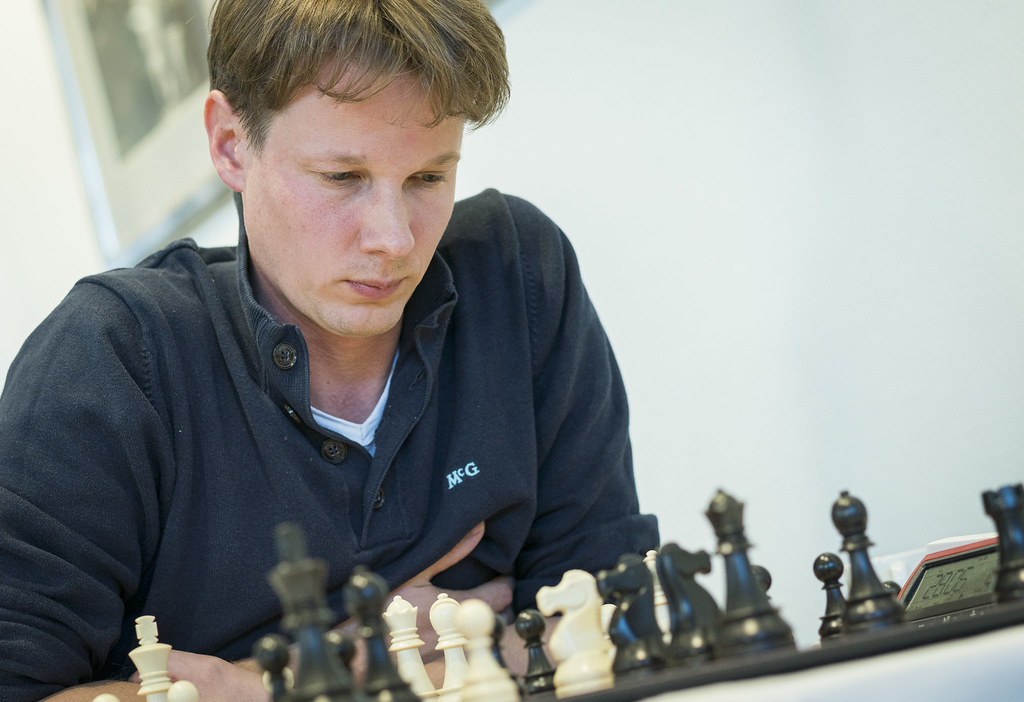
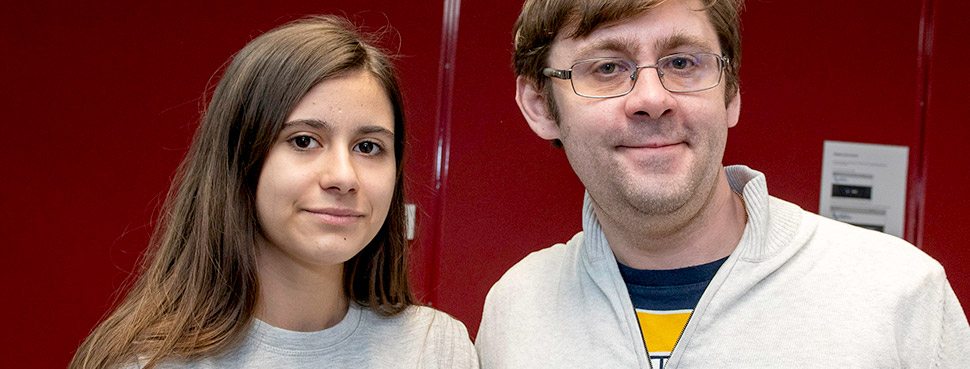
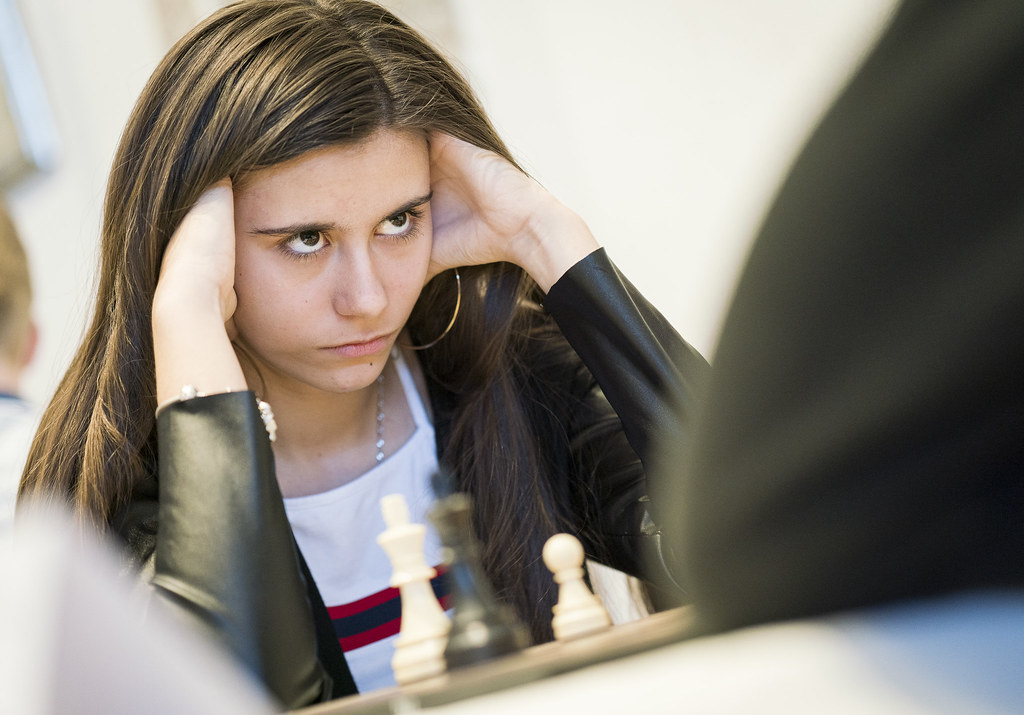
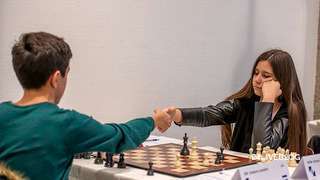
    Her play was a real sensation in this tournament. So much so that some of the players thought quite seriously that Viktoriia Kirchei (14) was cheating. That’s why all the four players who qualified for the semi-finals in the open were scanned and searched before yesterday’s game. Viktoriia and her father Sergey understand this. The scan didn’t produce anything incriminating, and they are glad the problem was solved in this way.

    Viktoriia is a hard-working girl, and English is one of the next things she is going to work on. She understands it but doesn’t speak any. ‘Yes, we understood the measures taken by the arbiters,’ her father Sergey says. ‘Viktoriia’s results here were very surprising – also for us. Normally she has difficulty to get a good position after the opening – especially in youth tournaments where everybody is preparing for each other. In this tournament they didn’t prepare for her, and besides she has also made progress with her openings. We think that there was also an element of psychology. Viktoriia is not afraid of losing against the players here.’ Whereas the opposite seemed to be the case with her opponents. Even several international masters went astray against her.

    Since three days Viktoriia has a nasty cold, and she and her father also had a long journey from Moscow to here, flying via Helsinki. ‘I liked my game in the semi-final [with Javokhir Sindarov],’ she said, looking back (translated by her father). ‘I missed a nice victory there but my play was good and I was satisfied. My loss was maybe due to time shortage. About today’s game [with Jan Werle] I am not satisfied. I couldn’t get a good position from the opening.’ She works 4 to 5 hours a day on chess and her coaches are grandmasters Sergey Dolmatov, with whom she mainly solves chess problems, and Nikolai Chadaev. In the European Youth Championships she ended 5th after a final-round loss to the eventual champion: ‘The pressure became too much.’

    Because of the language barrier Viktoriia was hard to approach during the tournament, but in the presence of her father she opens up and smiles a lot. She is very ambitious as a chess player. Her next event is the European rapid and blitz Championships in Tallinn, end of November. Her goal? To become a World Champion. Does she think she has a chance? ‘Certainly!’

  • Viktoriia Kirchei: not afraid to lose

    Viktoriia Kirchei: not afraid to lose

    Her play was a real sensation in this tournament. So much so that some of the players thought quite seriously that Viktoriia Kirchei (14) was cheating. That’s why all the four players who qualified for the semi-finals in the open were scanned and searched before yesterday’s game. Viktoriia and her father Sergey understand this. The scan didn’t produce anything incriminating, and they are glad the problem was solved in this way.

    Viktoriia is a hard-working girl, and English is one of the next things she is going to work on. She understands it but doesn’t speak any. ‘Yes, we understood the measures taken by the arbiters,’ her father Sergey says. ‘Viktoriia’s results here were very surprising – also for us. Normally she has difficulty to get a good position after the opening – especially in youth tournaments where everybody is preparing for each other. In this tournament they didn’t prepare for her, and besides she has also made progress with her openings. We think that there was also an element of psychology. Viktoriia is not afraid of losing against the players here.’ Whereas the opposite seemed to be the case with her opponents. Even several international masters went astray against her.

    Since three days Viktoriia has a nasty cold, and she and her father also had a long journey from Moscow to here, flying via Helsinki. ‘I liked my game in the semi-final [with Javokhir Sindarov],’ she said, looking back (translated by her father). ‘I missed a nice victory there but my play was good and I was satisfied. My loss was maybe due to time shortage. About today’s game [with Jan Werle] I am not satisfied. I couldn’t get a good position from the opening.’ She works 4 to 5 hours a day on chess and her coaches are grandmasters Sergey Dolmatov, with whom she mainly solves chess problems, and Nikolai Chadaev. In the European Youth Championships she ended 5th after a final-round loss to the eventual champion: ‘The pressure became too much.’

    Because of the language barrier Viktoriia was hard to approach during the tournament, but in the presence of her father she opens up and smiles a lot. She is very ambitious as a chess player. Her next event is the European rapid and blitz Championships in Tallinn, end of November. Her goal? To become a World Champion. Does she think she has a chance? ‘Certainly!’

  • Aleksandr Georgiev: ‘Maybe I’m not so bad at chess’

    Aleksandr Georgiev: ‘Maybe I’m not so bad at chess’

    Draughts World Champion Aleksandr Georgiev has finished on 5œ out of 7 in the Amateur II group. ‘It was very interesting,’ said the amiable Russian (44), ‘and I have seen here that maybe I’m not so bad at chess.’ Yesterday a few friends from the draughts scene came to visit Georgiev here in Hoogeveen, and they concluded the same as Aleksandr did: ‘A chess tournament is very similar to a draughts tournament. The main difference is that much more people are playing chess. I think this is not so much due to the character of the games, but more to the way the sports are organized.’

    After the first game Georgiev won at the Hoogeveen city hall, he wanted to put 2-0 on the score sheet, but he managed to correct himself in time. Although he may be the most successful draughts player of all time, he has always been quite familiar with chess. ‘In my home town St Petersburg we played draughts and chess in the same building. So I knew chess players early on. But I was lucky to get a very good draughts coach, Sergey Manchin, who had coached other world champions before. He also played chess. He told me he once was quite good as a draughts player himself, but then he saw Ton Sijbrands play, and decided to become a coach…’

    Georgiev has taken part in several mind sports events in China, where both chess and draughts are on the programme. ‘There I met Vasily Ivanchuk, who has been coaching me in chess. I had already seen him before, because Dutch draughts player Harm Wiersma knew him.’ Ivanchuk, a good draughts player who played a chess match with Wei Yi here two years ago, thinks quite highly of Georgiev as a chess player.

    The games itself have their differences, of course. Chess may be easier to visualize because there are so many different pieces. ‘Yes, but also the boards are different,’ Georgiev said. ‘The draughts board is bigger, but only half of the squares are used. Still, I think that if I could have found a good coach in St Petersburg, which is much more difficult there than with draughts because there is a lot of competition, I might have become a better chess player. I am planning to play more chess in the future – if I have the time. Also it depends if I get any invitations!’

  • Aleksandr Georgiev: ‘Maybe I’m not so bad at chess’

    Aleksandr Georgiev: ‘Maybe I’m not so bad at chess’

    Draughts World Champion Aleksandr Georgiev has finished on 5œ out of 7 in the Amateur II group. ‘It was very interesting,’ said the amiable Russian (44), ‘and I have seen here that maybe I’m not so bad at chess.’ Yesterday a few friends from the draughts scene came to visit Georgiev here in Hoogeveen, and they concluded the same as Aleksandr did: ‘A chess tournament is very similar to a draughts tournament. The main difference is that much more people are playing chess. I think this is not so much due to the character of the games, but more to the way the sports are organized.’

    After the first game Georgiev won at the Hoogeveen city hall, he wanted to put 2-0 on the score sheet, but he managed to correct himself in time. Although he may be the most successful draughts player of all time, he has always been quite familiar with chess. ‘In my home town St Petersburg we played draughts and chess in the same building. So I knew chess players early on. But I was lucky to get a very good draughts coach, Sergey Manchin, who had coached other world champions before. He also played chess. He told me he once was quite good as a draughts player himself, but then he saw Ton Sijbrands play, and decided to become a coach…’

    Georgiev has taken part in several mind sports events in China, where both chess and draughts are on the programme. ‘There I met Vasily Ivanchuk, who has been coaching me in chess. I had already seen him before, because Dutch draughts player Harm Wiersma knew him.’ Ivanchuk, a good draughts player who played a chess match with Wei Yi here two years ago, thinks quite highly of Georgiev as a chess player.

    The games itself have their differences, of course. Chess may be easier to visualize because there are so many different pieces. ‘Yes, but also the boards are different,’ Georgiev said. ‘The draughts board is bigger, but only half of the squares are used. Still, I think that if I could have found a good coach in St Petersburg, which is much more difficult there than with draughts because there is a lot of competition, I might have become a better chess player. I am planning to play more chess in the future – if I have the time. Also it depends if I get any invitations!’

  • Timman maintains the tension, Firouzja wins match, Sindarov and Ernst to final

    Timman maintains the tension, Firouzja wins match, Sindarov and Ernst to final

    In het Hoogeveen Schaaktoernooi nam Jan Timman vandaag genoegen met een remise in iets betere stelling tegen Zhansaya Abdumalik: ‘We hebben al een paar lange partijen gehad,’ zei de Arnhemse grootmeester. Ook Alireza Firouzja en Jorge Cori Tello kwamen na een interessant gevecht tot remise, waarmee Firouzja de match gewonnen heeft met 3œ punt. Morgen kan de IraniĂ«r vrijuit spelen – maar dat deed hij al!

    In de halve finales van het Open toernooi won de 13-jarige grootmeester Javokhir Sindarov met veel moeite van de 14-jarige Viktoriia Kirchei, die tegen het einde nog een dot van een kans had gemist. In de andere halve finale versloeg Sipke Ernst Jan Werle na een zware strijd. In de ‘rest’ van het Open toernooi staan nu Roeland Pruijssers en de 16-jarige IndiĂ«r Moksh Amit Doshi aan kop met 6œ punt.


    Live blog door Peter Boel


    Timman back to game 1!

    Again we have two Sicilians in the matches. Abdumalik-Timman started again with a 6.h3 Najdorf, as in the two previous games. Now, after 6…e6 7.g4, Timman harked back to 7…d5, the move that had such disastrous consequences for him in Game 1. This time, Abdumalik was the one to deviate: after 8.exd5 Nxd5 with the solid 9.Nde2. No accidents – now we have a game where Black looks quite solid and White’s pawn on g4 looks somewhat odd.

    Firouzja and Cori Tello put a Sveshnikov Sicilian on the board this time. That’s a new one for this event. Cori thought for some time about 6…d6, and even for a pretty long time about 9…gxf6 – not, of course, about with which piece he was going to take back, but more about what will happen afterwards.


    Semi-finals have started

    The semi-finals just started with Javokhir Sindarov-Viktoriia Kirchei and Ernst-Werle. All four qualifiers were scanned and searched before the game; nothing was found and the games started without incident.

     
    No quick draws

    In the first semi-final, Sindarov played a Closed Ruy Lopez with an early a2-a4 (on move 7). After 11…a5 the young Uzbek seems to have a pleasant advantage. The alternative was 11…Nxd5 and if 12.exd5 Na5.

    The two ‘Frisians’ Sipke Ernst and Jan Werle (neither of them lives in Frisia anymore) have a topical Catalan on the board. Ernst has now castled queenside, which looks quite daring. It doesn’t look like a quick draw – neither does board 1!

     
    The Sveshnikov

    Commentator Robert Ris gave some nice explanations of the Sveshnikov from Firouzja-Cori.

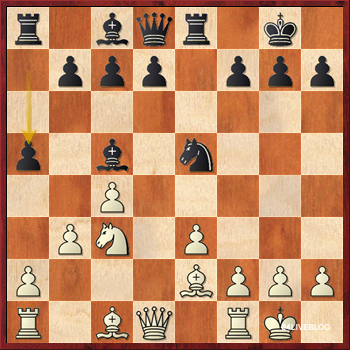
    Firouzja played 15.Qh5 here.

    In the past, players like Kramnik and Radjabov had played 15. Qf3, when Black has the interesting 15… d5. A move which, in fact, came on the board in the only Sveshnikov commentator Robert Ris ever played with black – against one of the spectators in the room, Richard Hendriks! The point is 16. exd5 e4 17. Qe3 Qa7! and White is in big trouble. Nice memories for Robert! White has to play 16. cxd5 fxe4 17. Bxe4 (17. Qxe4 f5) 17… Rb8 (17… f5? 18. d6) and now e.g. 18. Rad1 Rb6.


    Dangerous bishops

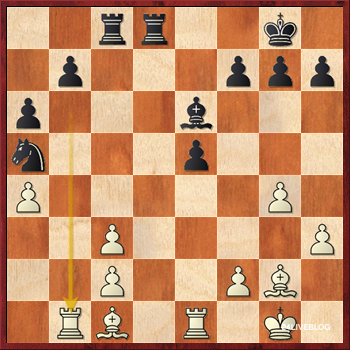
    White’s bishops are very dangerous, certainly now that the queens are off, and Jan Timman is hanging on by a thread. After his ingenious defensive move 18… Na5

    Abdumalik-Timman

    … it looked to commentator Robert Ris that 19. Ba3 would have been strong. But Black seems to have a good defence in 19… Rfc8 20. Bb4 Nc6! 21. Rxb7 Nxb4 and Black wins back one of the c-pawns.

    Abdumalik played 19.a4 and after 19… Rac8, 20. Ba3 again seemed interesting. But now Black would have had 20… Nc4! 22. Rxb7 a5 23. Be7 Rd2 and this is also enough for equality.

    Ris found the way Abdumalik played not dynamic enough for this type of position, however, and he may be right in that respect.

     
    Werle in trouble

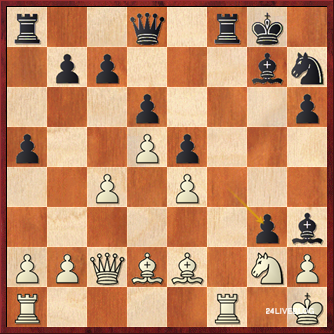
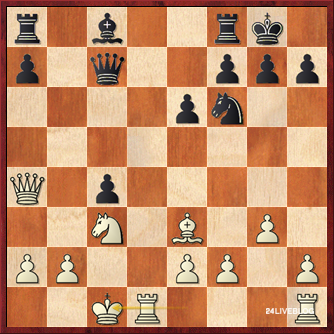
    Sipke Ernst may have surprised Jan Werle in the opening. After his 14.0-0-0…

    … Werle reacted in a seemingly logical way with 14…e5 and 15…Be6 whereas 14…Ng4 followed by 15…Nxe3 has been the preference of his colleague grandmasters. Then White also gets chances by doubling rooks on the d-file but Black gets counterchances against White’s weak pawns.

    As it went Sipke increased his pressure and now Werle is in trouble.

     
    Wins for Harutjunyan, Vrolijk and Takawira

    GM Gevorg Hatutjunyan beat Manush Shah quite quickly in the ‘rest open’ with a devastating attack. He allowed Black to take on g2 but that was nothing compared to his own attack on Black’s king, which was crowned by a ‘petit fourchette combinaison’ with 28.Bb5+.

    Liam Vrolijk’s win over Siem van Dael also looked attractive. His move 20.Nxf7 amounted to the sacrifice of a ‘small exchange’ but it was clear that Black could not survuve the attack with major pieces that followed immediately afterwards.

    Erick Takawira was lucky today. In a good pawn-up position, Leandro Slagboom’s 22.Nc5?? immediately lost a piece to 22…Rb6.

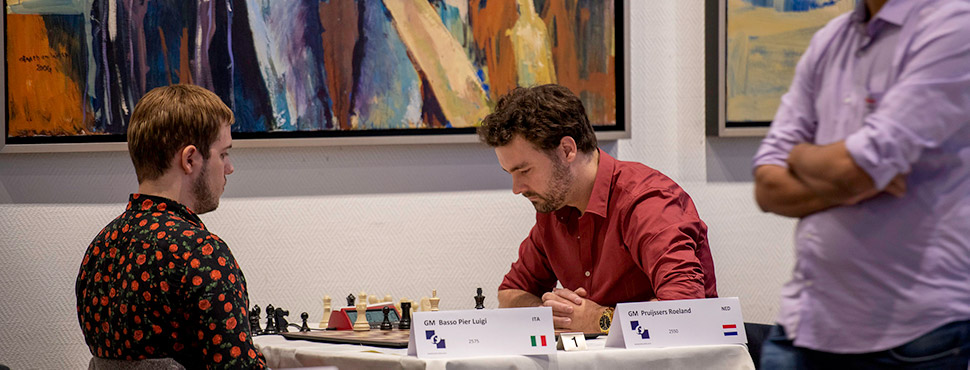
    On first board, Roeland Pruijssers is defending a slightly worse position against Pier Luigi Basso.

     
    Timman settles for a draw

    Jan Timman was slightly better in the end position because of White’s exposed king, but settled for a draw: ‘I’m a bit tired, and we already had several long games,’ he admitted. ‘Besides it would have been very difficult to win.’

    Both players agreed that the line under discussion is quite interesting. ‘There are some very nice exchange sacrifices in the position,’ said Timman without giving away anything further. The Dutch great-grandmaster played it safe not only by taking the draw, but also by playing 11…Bxc3 instead of 11…Nxc3 12.Nxc3 bxc3 13.Qc7. ’14.Qf3 was a bad move,’ Abdumalik said – it was more or less a loss of time. Timman recalled that 14. Rb1 had been played – his preparation had been thorough.

    Even without queens there were enough tactics left:

    Timman played the sound 21…f6 here, when 21… Rxc3 22. Bg5 f6 23. Rxe5 Ba2 would have led to ‘some crazy lines’, as Abdumalik said. ‘But Black can defend in all the lines, although it can be difficult,’ Timman added. As it went the game quickly petered out to 2R’s + B vs 2R’s + B with a high drawing probability.

     
    Great recovery by Cori

    Jorge Cori Tello’s recovery is remarkable. With black in the Sveshnikov he has played well and acquired a slight advantage with his bishop pair, thanks to the standard trick 16…e4 and …Bxb2. Whether it is enough for a win is questionable, but here a quite different player is at work than in the first three rounds.

     
    Kirchei misses a win

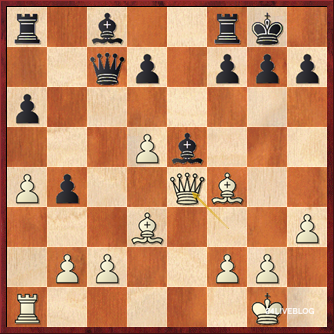
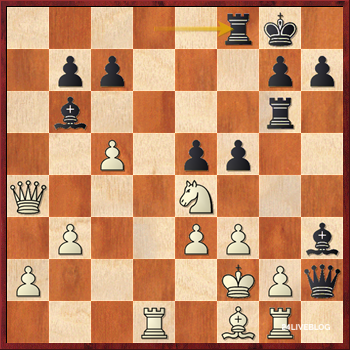
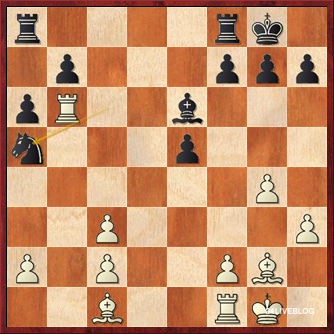
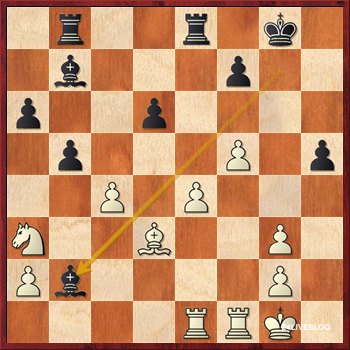
    Viktoriia Kirchei is playing excellently again. From the following position things could have gone very wrong for Javokhir Sindarov:

    White played 29. Nxc7? here after which the Russian girl could have brilliantly replied 29… Ncd4! with the big threat of 30… Nc2, when the white queen can no longer defend her king. Of course also 30. cxd4 exd4 would lose for White.

     
    Beerdsen wins

    Thomas Beerdsen has also recovered from his defeat against the indomitable Viktoriia Kirchei. He survived a sacrificial attack by 15-year-old Onno Elgersma and remained a piece up. Grandmaster Romanishin and Jonkman have drawn, and Pruijssers has survived the worst against Basso and is now trying to win a pawn-up rook ending.

     
    Firouzja is cruising for a draw

    Alireza Firouzja has survived the worst and has even kept his extra (doubled) pawn. This looks like a draw, which would mean match victory for the Iranian.

     
    We have a tournament winner!

    Local hero Andries Mellema has 7 out of 7 in the Amateur I group and can no longer be caught by his rivals. For Hoogeveen boy Mellema it’s the third time he has won an Amateur group here!

     
    Sindarov reaches the final!

    After surviving Viktoriia Kirchei’s initiative (and she missed her big chance) Javokhir Sindarov managed to consolidate and when Kirchei played 37…e4 that made it easier for the one-year-younger Uzbek. He left the playing hall quickly but he must have been quite relieved!

    Viktoriia Kirchei resigns

     
    Firouzja and Cori draw

    After the draw agreement Firouzja and Cori analysed the bishops of opposite colours endgame for quite a while. Cori thought he was still in some danger there.

    Firouzja had got confused in the opening – ‘I don’t yet know what, but I think 15.Qh5 was bad.’ 15.Qf3 was known, as we saw before, but it was only after 19.f3 (19.cxb5) that Black could take over with 19…h5 and 20…Qe5.

    After Black took on b2…

    … Firouzja was very glad to have 23. Nb1, as after 23. Nc2 bxc4 24. Bxc4 Bxe4 things would have looked more grim for him. Now Firouzja thought 23… b4 would have been better than the game move 23… bxc4, because the possibility of a passed pawn on the queenside combined with the bishop pair would have been daunting for White.

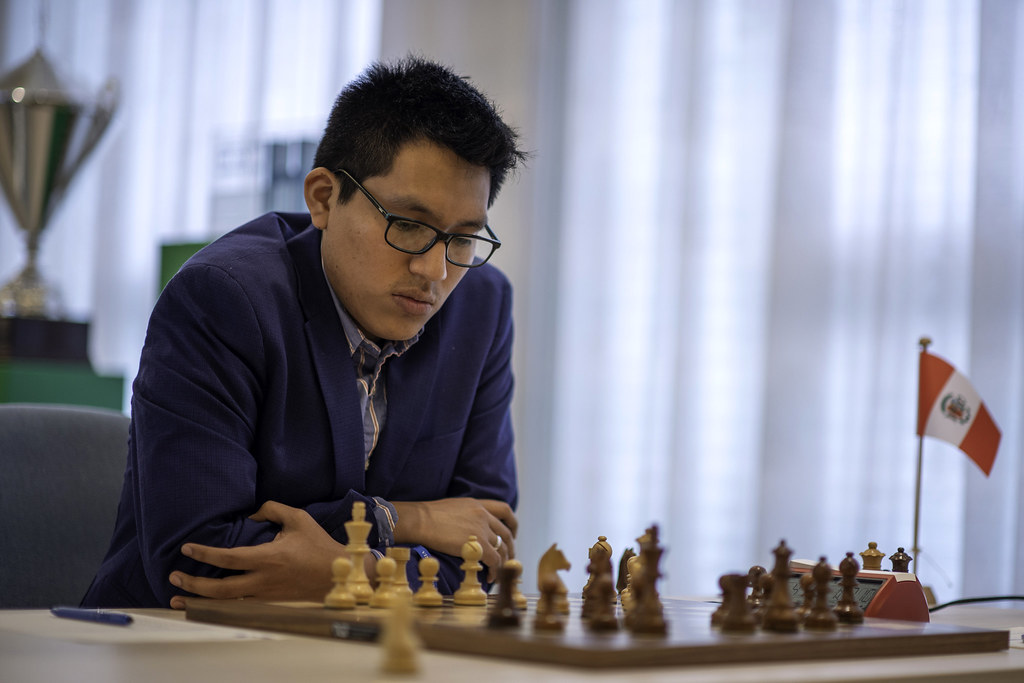
    Was Cori satisfied with the 1.5 point he obtained in the past few days? ‘Mmm…’ ‘Okay, I suppose it could have been better,’ we tried. ‘Could have been worse too!’, the Peruvian replied. Still, these 1.5 points were fully deserved.

    The match has been decided, and when chief arbiter Frans Peeters confirmed to Firouzja that the final game won’t be rated (according to the rules), the Iranian reacted ‘OK, then we can go wild!’

     
    Ernst heading for the final

    Jan Werle has been deperately vying for counterchances for a few hours now but so far Sipke Ernst is very soundly nursing his advantage to a win. He is two pawns up. Are we getting a Sindarov-Ernst final? Their game in the ‘regular’ tournament was exciting enough.

     
    Wins for Doshi and Schoppen

    16-year-old Moksh Amit Doshi probably has an IM-norm already – we will look for confirmation later! This would be already his 7th IM norm – so the only thing he needs is 2400 Elo points.

    Today the Indian beat German IM Georg Seul by sackin a pawn on the queenside, for which he got an initiative on the kingside. He played very strongly there and eventually won an exchange, and the game. Doshi is also in the race for victory in the ‘rest Open’ – he is on 6.5 now. Pruijssers can draw even but for that he will have to win a pawn-plus rook ending from Pier Luigi Basso.

    Casper Schoppen is on 5.5 now. He beat Nichita Morozov, who played 26…f6 which turned out to be a slight weakening. With iron logic Schoppen encircled the f6-pawn and won it, and the game.

     
    Pruijssers wins it

    Pruijssers has won the rook ending, and is now with Doshi on 6.5.

     
    Ernst wins!

    Sipke Ernst has made it to the final with a fine game. He was always much better, but Jan Werle kept fighting for his life for several hours. It wasn’t enough – in the end Ernst’s c-pawn, shielded by his extra knight, decided the issue.

     
    Timman keeps the tension, Firouzja wins match, Sindarov and Ernst to Open final

    Today, Jan Timman settled for a draw in a slightly better position against Zhansaya Abdumalik: ‘We’ve already had a few long games,’ the grandmaster from Arnhem said. So the final decision in this match will fall tomorrow. Alireza Firouzja and Jorge Cori Tello also drew after an interesting fight, which means that Firouzja has already won the match with 3œ points. So tomorrow the Iranian can play freely – as if he wasn’t doing that already!

    In the semi-finals of the Open, 13-year-old grandmaster Javokhir Sindarov had a lot of trouble beating 14-year-old Viktoriia Kirchei, who even missed a big chance towards the end of the game. In the other semi-final, Sipke Ernst bested Jan Werle after a heavy struggle. In the ‘rest Open’, Roeland Pruijssers and the 16-year-old Indian are leading with 6œ point.

  • Timman houdt de spanning erin, Firouzja wint match, Sindarov en Ernst naar finale Open

    Timman houdt de spanning erin, Firouzja wint match, Sindarov en Ernst naar finale Open

    In het Hoogeveen Schaaktoernooi nam Jan Timman vandaag genoegen met een remise in iets betere stelling tegen Zhansaya Abdumalik: ‘We hebben al een paar lange partijen gehad,’ zei de Arnhemse grootmeester. Ook Alireza Firouzja en Jorge Cori Tello kwamen na een interessant gevecht tot remise, waarmee Firouzja de match gewonnen heeft met 3œ punt. Morgen kan de IraniĂ«r vrijuit spelen – maar dat deed hij al!

    In de halve finales van het Open toernooi won de 13-jarige grootmeester Javokhir Sindarov met veel moeite van de 14-jarige Viktoriia Kirchei, die tegen het einde nog een dot van een kans had gemist. In de andere halve finale versloeg Sipke Ernst Jan Werle na een zware strijd. In de ‘rest’ van het Open toernooi staan nu Roeland Pruijssers en de 16-jarige IndiĂ«r Moksh Amit Doshi aan kop met 6œ punt.

    Live blog door Peter Boel


    Timman back to game 1!

    Again we have two Sicilians in the matches. Abdumalik-Timman started again with a 6.h3 Najdorf, as in the two previous games. Now, after 6…e6 7.g4, Timman harked back to 7…d5, the move that had such disastrous consequences for him in Game 1. This time, Abdumalik was the one to deviate: after 8.exd5 Nxd5 with the solid 9.Nde2. No accidents – now we have a game where Black looks quite solid and White’s pawn on g4 looks somewhat odd.

    Firouzja and Cori Tello put a Sveshnikov Sicilian on the board this time. That’s a new one for this event. Cori thought for some time about 6…d6, and even for a pretty long time about 9…gxf6 – not, of course, about with which piece he was going to take back, but more about what will happen afterwards.


    Semi-finals have started

    The semi-finals just started with Javokhir Sindarov-Viktoriia Kirchei and Ernst-Werle. All four qualifiers were scanned and searched before the game; nothing was found and the games started without incident.

     
    No quick draws

    In the first semi-final, Sindarov played a Closed Ruy Lopez with an early a2-a4 (on move 7). After 11…a5 the young Uzbek seems to have a pleasant advantage. The alternative was 11…Nxd5 and if 12.exd5 Na5.

    The two ‘Frisians’ Sipke Ernst and Jan Werle (neither of them lives in Frisia anymore) have a topical Catalan on the board. Ernst has now castled queenside, which looks quite daring. It doesn’t look like a quick draw – neither does board 1!

     
    The Sveshnikov

    Commentator Robert Ris gave some nice explanations of the Sveshnikov from Firouzja-Cori.

    Firouzja played 15.Qh5 here.

    In the past, players like Kramnik and Radjabov had played 15. Qf3, when Black has the interesting 15… d5. A move which, in fact, came on the board in the only Sveshnikov commentator Robert Ris ever played with black – against one of the spectators in the room, Richard Hendriks! The point is 16. exd5 e4 17. Qe3 Qa7! and White is in big trouble. Nice memories for Robert! White has to play 16. cxd5 fxe4 17. Bxe4 (17. Qxe4 f5) 17… Rb8 (17… f5? 18. d6) and now e.g. 18. Rad1 Rb6.


    Dangerous bishops

    White’s bishops are very dangerous, certainly now that the queens are off, and Jan Timman is hanging on by a thread. After his ingenious defensive move 18… Na5

    Abdumalik-Timman

    … it looked to commentator Robert Ris that 19. Ba3 would have been strong. But Black seems to have a good defence in 19… Rfc8 20. Bb4 Nc6! 21. Rxb7 Nxb4 and Black wins back one of the c-pawns.

    Abdumalik played 19.a4 and after 19… Rac8, 20. Ba3 again seemed interesting. But now Black would have had 20… Nc4! 22. Rxb7 a5 23. Be7 Rd2 and this is also enough for equality.

    Ris found the way Abdumalik played not dynamic enough for this type of position, however, and he may be right in that respect.

     
    Werle in trouble

    Sipke Ernst may have surprised Jan Werle in the opening. After his 14.0-0-0…

    … Werle reacted in a seemingly logical way with 14…e5 and 15…Be6 whereas 14…Ng4 followed by 15…Nxe3 has been the preference of his colleague grandmasters. Then White also gets chances by doubling rooks on the d-file but Black gets counterchances against White’s weak pawns.

    As it went Sipke increased his pressure and now Werle is in trouble.

     
    Wins for Harutjunyan, Vrolijk and Takawira

    GM Gevorg Hatutjunyan beat Manush Shah quite quickly in the ‘rest open’ with a devastating attack. He allowed Black to take on g2 but that was nothing compared to his own attack on Black’s king, which was crowned by a ‘petit fourchette combinaison’ with 28.Bb5+.

    Liam Vrolijk’s win over Siem van Dael also looked attractive. His move 20.Nxf7 amounted to the sacrifice of a ‘small exchange’ but it was clear that Black could not survuve the attack with major pieces that followed immediately afterwards.

    Erick Takawira was lucky today. In a good pawn-up position, Leandro Slagboom’s 22.Nc5?? immediately lost a piece to 22…Rb6.

    On first board, Roeland Pruijssers is defending a slightly worse position against Pier Luigi Basso.

     
    Timman settles for a draw

    Jan Timman was slightly better in the end position because of White’s exposed king, but settled for a draw: ‘I’m a bit tired, and we already had several long games,’ he admitted. ‘Besides it would have been very difficult to win.’

    Both players agreed that the line under discussion is quite interesting. ‘There are some very nice exchange sacrifices in the position,’ said Timman without giving away anything further. The Dutch great-grandmaster played it safe not only by taking the draw, but also by playing 11…Bxc3 instead of 11…Nxc3 12.Nxc3 bxc3 13.Qc7. ’14.Qf3 was a bad move,’ Abdumalik said – it was more or less a loss of time. Timman recalled that 14. Rb1 had been played – his preparation had been thorough.

    Even without queens there were enough tactics left:

    Timman played the sound 21…f6 here, when 21… Rxc3 22. Bg5 f6 23. Rxe5 Ba2 would have led to ‘some crazy lines’, as Abdumalik said. ‘But Black can defend in all the lines, although it can be difficult,’ Timman added. As it went the game quickly petered out to 2R’s + B vs 2R’s + B with a high drawing probability.

     
    Great recovery by Cori

    Jorge Cori Tello’s recovery is remarkable. With black in the Sveshnikov he has played well and acquired a slight advantage with his bishop pair, thanks to the standard trick 16…e4 and …Bxb2. Whether it is enough for a win is questionable, but here a quite different player is at work than in the first three rounds.

     
    Kirchei misses a win

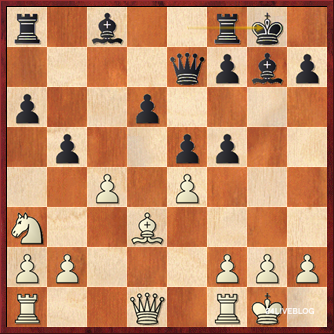
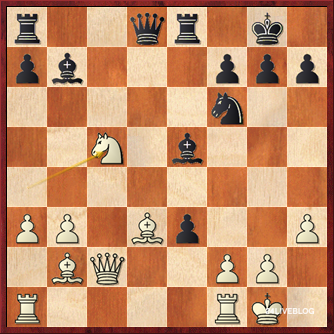
    Viktoriia Kirchei is playing excellently again. From the following position things could have gone very wrong for Javokhir Sindarov:

    White played 29. Nxc7? here after which the Russian girl could have brilliantly replied 29… Ncd4! with the big threat of 30… Nc2, when the white queen can no longer defend her king. Of course also 30. cxd4 exd4 would lose for White.

     
    Beerdsen wins

    Thomas Beerdsen has also recovered from his defeat against the indomitable Viktoriia Kirchei. He survived a sacrificial attack by 15-year-old Onno Elgersma and remained a piece up. Grandmaster Romanishin and Jonkman have drawn, and Pruijssers has survived the worst against Basso and is now trying to win a pawn-up rook ending.

     
    Firouzja is cruising for a draw

    Alireza Firouzja has survived the worst and has even kept his extra (doubled) pawn. This looks like a draw, which would mean match victory for the Iranian.

     
    We have a tournament winner!

    Local hero Andries Mellema has 7 out of 7 in the Amateur I group and can no longer be caught by his rivals. For Hoogeveen boy Mellema it’s the third time he has won an Amateur group here!

     
    Sindarov reaches the final!

    After surviving Viktoriia Kirchei’s initiative (and she missed her big chance) Javokhir Sindarov managed to consolidate and when Kirchei played 37…e4 that made it easier for the one-year-younger Uzbek. He left the playing hall quickly but he must have been quite relieved!

    Viktoriia Kirchei resigns

     
    Firouzja and Cori draw

    After the draw agreement Firouzja and Cori analysed the bishops of opposite colours endgame for quite a while. Cori thought he was still in some danger there.

    Firouzja had got confused in the opening – ‘I don’t yet know what, but I think 15.Qh5 was bad.’ 15.Qf3 was known, as we saw before, but it was only after 19.f3 (19.cxb5) that Black could take over with 19…h5 and 20…Qe5.

    After Black took on b2…

    … Firouzja was very glad to have 23. Nb1, as after 23. Nc2 bxc4 24. Bxc4 Bxe4 things would have looked more grim for him. Now Firouzja thought 23… b4 would have been better than the game move 23… bxc4, because the possibility of a passed pawn on the queenside combined with the bishop pair would have been daunting for White.

    Was Cori satisfied with the 1.5 point he obtained in the past few days? ‘Mmm…’ ‘Okay, I suppose it could have been better,’ we tried. ‘Could have been worse too!’, the Peruvian replied. Still, these 1.5 points were fully deserved.

    The match has been decided, and when chief arbiter Frans Peeters confirmed to Firouzja that the final game won’t be rated (according to the rules), the Iranian reacted ‘OK, then we can go wild!’

     
    Ernst heading for the final

    Jan Werle has been deperately vying for counterchances for a few hours now but so far Sipke Ernst is very soundly nursing his advantage to a win. He is two pawns up. Are we getting a Sindarov-Ernst final? Their game in the ‘regular’ tournament was exciting enough.

     
    Wins for Doshi and Schoppen

    16-year-old Moksh Amit Doshi probably has an IM-norm already – we will look for confirmation later! This would be already his 7th IM norm – so the only thing he needs is 2400 Elo points.

    Today the Indian beat German IM Georg Seul by sackin a pawn on the queenside, for which he got an initiative on the kingside. He played very strongly there and eventually won an exchange, and the game. Doshi is also in the race for victory in the ‘rest Open’ – he is on 6.5 now. Pruijssers can draw even but for that he will have to win a pawn-plus rook ending from Pier Luigi Basso.

    Casper Schoppen is on 5.5 now. He beat Nichita Morozov, who played 26…f6 which turned out to be a slight weakening. With iron logic Schoppen encircled the f6-pawn and won it, and the game.

     
    Pruijssers wins it

    Pruijssers has won the rook ending, and is now with Doshi on 6.5.

     
    Ernst wins!

    Sipke Ernst has made it to the final with a fine game. He was always much better, but Jan Werle kept fighting for his life for several hours. It wasn’t enough – in the end Ernst’s c-pawn, shielded by his extra knight, decided the issue.

     
    Timman keeps the tension, Firouzja wins match, Sindarov and Ernst to Open final

    Today, Jan Timman settled for a draw in a slightly better position against Zhansaya Abdumalik: ‘We’ve already had a few long games,’ the grandmaster from Arnhem said. So the final decision in this match will fall tomorrow. Alireza Firouzja and Jorge Cori Tello also drew after an interesting fight, which means that Firouzja has already won the match with 3œ points. So tomorrow the Iranian can play freely – as if he wasn’t doing that already!

    In the semi-finals of the Open, 13-year-old grandmaster Javokhir Sindarov had a lot of trouble beating 14-year-old Viktoriia Kirchei, who even missed a big chance towards the end of the game. In the other semi-final, Sipke Ernst bested Jan Werle after a heavy struggle. In the ‘rest Open’, Roeland Pruijssers and the 16-year-old Indian are leading with 6œ point.

  • Timman and Cori win; Sindarov, Werle, Ernst and Kirchei to semi-finals

    Timman and Cori win; Sindarov, Werle, Ernst and Kirchei to semi-finals

    Prizes

    The 6th round has started. Loek van Wely handed out prizes for games from the 5th as well as the 6th round.
    A prize went to Machteld van Foreest for her nice endgame win over Dylan Achuthan. The other was awarded to Dev Shah for an interesting game with two exchange sacrifices against Bas de Boer.

    The prize for the 6th round was given to local hero Sander Taams, who played a creative attacking game against Dr. Axel Fehr. Taams arrived just in time to collect his book.

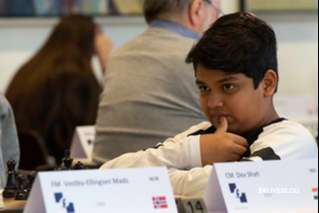
    12-year-old Dev Shah, the winner of one of the two brilliancy prizes in round 5

    Chief arbiter Frans Peeters announced that after today’s round, the four qualifiers for the separate semi-finals will be known. In case of a tie, the TPR will determine who qualifies, and Peeters will inform the players concerned as soon as possible after the game.

    By the way, Hector Giacomini has a win by default today because his opponent, Katharina Ricken, has withdrawn from the tournament.

     
    Two more GrĂŒnfelds

    The matches are showing two GrĂŒnfelds again, even though Jorge Cori started with 1.c4 today. This game has turned into a Fianchetto GrĂŒnfeld. In the other game Timman first reacted with 4.Nf3 again, like in Game 2, but after 4…Bg7 took on d5 this time and the game has transposed to a ‘regular’ Exchange GrĂŒnfeld with 7.Nf3 with Abdumalik playing 8…Bg4.

    Today Alireza Firouzja can already win his match! But Jorge Cori looks determined – he will do everything in his power to turn the tide.

     
    Draw on top board

    As could be expected, Jan Werle and Javokhir Sindarov made an ultra-quick draw on top board. This way Sindarov immediately qualified for the semi-finals, whereas Jan Werle has a huge chance of doing the same.

     
    No knight on the rim for Cori

    With a different move order Cori and Firouzja reached the same position as in Game 2. Cori deviated on move 10 from 10.Nh4, which didn’t turn out very pleasant for him, and played the ‘normal’ 10.Re1, to which Firouzja reacted with the well-known push of his a-pawn to a4.

     
    Pruijssers sacks a piece in the Najdorf

    Roeland Pruijssers is going for the semi-finals! He has played a known bishop sacrifice in the Najdorf, which is also seen in several other open Sicilians. White also gets the pawn on d6, so now that the queens are off White can just try to convert his three pawns for the piece. An interesting concept!

     
    Hilwerda sacks one too

    Jonas Hilwerda is starting to get optimistic after yesterday’s win over Liam Vrolijk. He has just sacrificed a knight on h6 against experienced GM Gevorg Harutjunyan – a quite well-known sacrifice in the Caro-Kann, by the way.

     
    Taams goes for double

    Sander Taams cashed in a brilliancy prize today, and this afternoon he is going for a second one! He has made a very interesting piece sacrifice against Bas de Boer which looks promising, although Black gets attacking chances too. Keep watching this game!

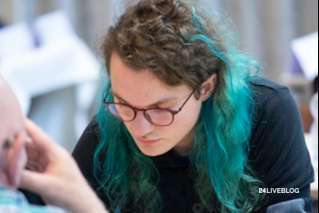
    Sander Taams, whose play is as colourful as his hair

     
    Schoppen misses a quick win

    Casper Schoppen is doing well in a very sharp game against Shah Manush, but he missed a quick win.

    Manush-Schoppen

    The game move 17…Bxb2 was good enough for an edge, but much stronger would have been 17…Bxg2! with the point 18.Kxg2 Bxb2 19.Qxb2 Qd5+ and 20…Qxc5+, when White can probably resign because of his shattered kingside structure.

     
    Draw on board 2

    Sipke Ernst has all but qualified for the semi-finals by drawing with Pier Luigi Basso from a position of strength: ‘I offered him a draw after 20.e4 in a fantastic position. I really thought it was now or never for him. He shouldn’t have let me force 12…bxc6, then it is very bad for Black. He should have played 11…Bd7, and later instead of fianchettoing the other bishop maybe …h7-h6 and …Bd6. With the fianchetto the c5-square is also weakened.”

    Basso realized he was never going to win this game and offered a draw himself on move 22. Now he has to wait what the 4.5 players will do.

     
    Pawn sac Firouzja

    Alirezo Firouzja has been playing very actively again. He played his rook to a5, knight to b4 and bishop to c3, but this time Cori has reacted carefully, slowly driving back the enemy pieces, and had a nice little edge. Firouzja now optimistically sacks a pawn with 22…Qc4!?.

     
    Unusual pawn structure

    In Timman-Abdumalik a very unusual pawn structure has emerged. White has a strong pawn centre, Black a big majority on the queenside. However this may easily peter down to a draw after some general liquidation.

     
    Ganesan in trouble

    Akash Ganesan, who played so well up till now, is in big trouble against his young compatriot Moksh Amit Doshi. After 10…b4 he probably should have played the more active 11.Na4 instead of 11.Nd1. Now Doshi could take over with 11…e5, and since White hasn’t been able to castle queenside, he is on the receiving end of the attack.

     
    Hilwerda can sac his queen

    Harutjunyan’s 25…Nxc5 looks like a mistake. Hilwerda can now play the brilliant 26.Ne5! with the beautiful point 26…Nxd3 27.Nxf7+ Kg8 28.Bxe7+ Kxf7 29.Rg7 mate!

     
    Doshi wins!

    Moksh Amit Doshi wins! He was already much better due to his compatriot Akash Ganesan and kept his cool, winning in the attack. Doshi is only 16 years old and even has some chance to qualify for the semi-finals, in which case we would have a 13-year-old and a 16-year-old in the playoffs!

     
    Kirchei also on her way…?

    Viktoria Kirchei looks to be outplaying Thomas Beerdsen from an approximately equal position. Beerdsen will soon be looking at a monster of a pawn on a2. If Kirchei (14!) wins she will probably have the best TPR after Ernst and Werle…

     
    Kirchei yes

    She has won the game! This means that the 14-year-old Russian talent has qualified as the 4th player for the semi-finals. She has a better TPR than both Doshi and Pruijssers, should he beat Okkes.

    Kirchei in an earlier round

     
    Firouzja blunders

    Alireza Firouzja, while looking for compensation for his shedded pawn, made a horrible blunder: 37…Bd6? simply lost an exchange to 38.Nd7. The Iranian was looking resignedly into the audience, but hasn’t resigned yet!

     
    Is Abdumalik spoiling the draw?

    It looks as if Timman has winning chances in this tricky rook ending. Abdumalik’s 37…Ra8? was a strange move in an equal position. She may have intended to give checks from the side but White can interpose his rook on the d- or even the c-file. This looks winning for the Dutchman.

     
    First point for Cori Tello

    Jorge Cori Tello was very relieved to get his first (full!) point in the match with Alireza Firouzja. ‘I thought 22…Qc6 was playable but he gave some line with 23.Qxc6 bxc6 but he gave some line with 24.Ne4 c5 where White was better. When I won the pawn he was still playing all around the board. I needed to defend. I told myself, just like in the third game: “Don’t make a mistake now, don’t make a mistake. He is very good at complicated positions, better than me.” Two days ago it went wrong, today it didn’t. The 37…Bd6 blunder put an end to the game effectively. ‘Thank God he played that, because I didn’t see how I was going to win.”

    So this match still isn’t decided yet!

    Firouzja resigns

     
    Incredible finish

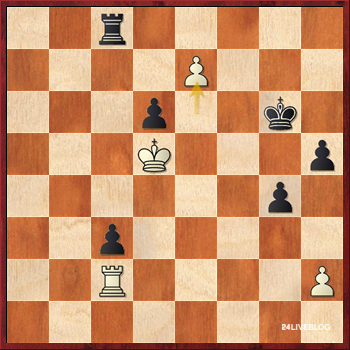
    It was quite incredible the way Jan Timman won the fourth game against Zhansaya Abdumalik.

    Timman-Abdumalik

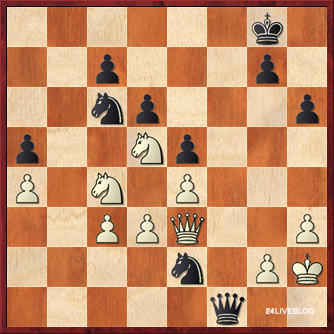
    Why did the Kazakh player played the ‘mysterious rook move’ 42…Ra8 ? Well, she had seen the following 5 moves, but…

    ‘I didn’t see his move 48.Ra4,’ Zhansaya said. ‘Otherwise 48…g3 probably draws.’ After that the Dutch GM brought a very elegant zugzwang position on the board.

    Abdumalik thought that, instead of 42…Ra8 (see first diagram), 42…Kf6 or 42…Kf7 would lose to 43.Kxd6 followed by 44.Rf2, but Black can play 43…Ra8 when her rook is on the long side, with a draw even if all the other pawns are off.

    So we see that even on this level rook endgames are still very, very difficult.

    Abdumalik resigns

     
    Pruijssers wins

    Roeland Pruijssers finally hauled in the point after a long struggle with Menno Okkes (who had prepared the piece sac line that came on the board!), and thought he had qualified for the semi-finals. Alas, chief arbiter Frans Peeters had to disappoint him: it is Viktoriia Kirchei who is placed 4th on TPR.

     
    Timman and Cori win; Sindarov, Werle, Ernst and Kirchei to semi-finals

    Another spectacular round in the matches today. Alireza Firouzja, who was leading 3-0 against Jorge Cori Tello, played too optimistically with his pieces. This time Cori reacted very calmly and carefully, and cashed in a pawn, but only when Firouzja blundered the game was really finished. Zhansaya Abdumalik went wrong in a tricky rook ending against Jan Timman and lost. Thus, the Dutchman took the lead for the first time in the match.

    In the Open, Jan Werle and Javokhir Sindarov drew very quickly and thereby qualified for the sem-finals. Sipke Ernst did the same with a draw from a superior position against Italian GM Pier Luigi Basso. To the surprise of many, 14-year-old Russian girl Viktoriia Kirchei qualified with a victory over Thomas Beerdsen. She had just a tiny edge on Roeland Pruijssers according to their rating performance.

  • Timman en Cori winnen; Sindarov, Werle, Ernst en Kirchei naar de halve finale

    Timman en Cori winnen; Sindarov, Werle, Ernst en Kirchei naar de halve finale

    Weer een spectaculaire ronde in de matches vandaag. Alireza Firouzja, die met 3-0 leidde tegen Jorge Cori Tello, speelde te optimistisch met zijn stukken. Ditmaal deed Cori het heel rustig en hij incasseerde een pion, maar pas na een volgende blunder van Firouzja was het echt afgelopen. Zhansaya Abdumalik ging tegen Jan Timman de mist in in een lastig toreneindspel en verloor, waardoor de Nederlander voor het eerst de leiding in de match nam.
     
    In het Open toernooi maakten Jan Werle en Javokhir Sindarov zeer snel remise en daarmee plaatsten ze zich voor de kruisfinales. Sipke Ernst deed dat ook via een remise vanuit betere stelling met de Italiaanse grootmeester Pier Luigi Basso. Tot veler verrassing plaatste de 14-jarige Russische Viktoriia Kirchei zich na een zege op Thomas Beerdsen. Ze had een piepkleine voorsprong op Roeland Pruijssers volgens de toernooiprestatierating.

    Live blog door Peter Boel

    Prizes

    The 6th round has started. Loek van Wely handed out prizes for games from the 5th as well as the 6th round.
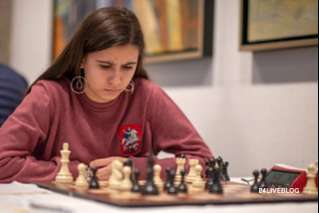
    A prize went to Machteld van Foreest for her nice endgame win over Dylan Achuthan. The other was awarded to Dev Shah for an interesting game with two exchange sacrifices against Bas de Boer.

    The prize for the 6th round was given to local hero Sander Taams, who played a creative attacking game against Dr. Axel Fehr. Taams arrived just in time to collect his book.

    12-year-old Dev Shah, the winner of one of the two brilliancy prizes in round 5

    Chief arbiter Frans Peeters announced that after today’s round, the four qualifiers for the separate semi-finals will be known. In case of a tie, the TPR will determine who qualifies, and Peeters will inform the players concerned as soon as possible after the game.

    By the way, Hector Giacomini has a win by default today because his opponent, Katharina Ricken, has withdrawn from the tournament.

     
    Two more GrĂŒnfelds

    The matches are showing two GrĂŒnfelds again, even though Jorge Cori started with 1.c4 today. This game has turned into a Fianchetto GrĂŒnfeld. In the other game Timman first reacted with 4.Nf3 again, like in Game 2, but after 4…Bg7 took on d5 this time and the game has transposed to a ‘regular’ Exchange GrĂŒnfeld with 7.Nf3 with Abdumalik playing 8…Bg4.

    Today Alireza Firouzja can already win his match! But Jorge Cori looks determined – he will do everything in his power to turn the tide.

     
    Draw on top board

    As could be expected, Jan Werle and Javokhir Sindarov made an ultra-quick draw on top board. This way Sindarov immediately qualified for the semi-finals, whereas Jan Werle has a huge chance of doing the same.

     
    No knight on the rim for Cori

    With a different move order Cori and Firouzja reached the same position as in Game 2. Cori deviated on move 10 from 10.Nh4, which didn’t turn out very pleasant for him, and played the ‘normal’ 10.Re1, to which Firouzja reacted with the well-known push of his a-pawn to a4.

     
    Pruijssers sacks a piece in the Najdorf

    Roeland Pruijssers is going for the semi-finals! He has played a known bishop sacrifice in the Najdorf, which is also seen in several other open Sicilians. White also gets the pawn on d6, so now that the queens are off White can just try to convert his three pawns for the piece. An interesting concept!

     
    Hilwerda sacks one too

    Jonas Hilwerda is starting to get optimistic after yesterday’s win over Liam Vrolijk. He has just sacrificed a knight on h6 against experienced GM Gevorg Harutjunyan – a quite well-known sacrifice in the Caro-Kann, by the way.

     
    Taams goes for double

    Sander Taams cashed in a brilliancy prize today, and this afternoon he is going for a second one! He has made a very interesting piece sacrifice against Bas de Boer which looks promising, although Black gets attacking chances too. Keep watching this game!

    Sander Taams, whose play is as colourful as his hair

     
    Schoppen misses a quick win

    Casper Schoppen is doing well in a very sharp game against Shah Manush, but he missed a quick win.

    Manush-Schoppen

    The game move 17…Bxb2 was good enough for an edge, but much stronger would have been 17…Bxg2! with the point 18.Kxg2 Bxb2 19.Qxb2 Qd5+ and 20…Qxc5+, when White can probably resign because of his shattered kingside structure.

     
    Draw on board 2

    Sipke Ernst has all but qualified for the semi-finals by drawing with Pier Luigi Basso from a position of strength: ‘I offered him a draw after 20.e4 in a fantastic position. I really thought it was now or never for him. He shouldn’t have let me force 12…bxc6, then it is very bad for Black. He should have played 11…Bd7, and later instead of fianchettoing the other bishop maybe …h7-h6 and …Bd6. With the fianchetto the c5-square is also weakened.”

    Basso realized he was never going to win this game and offered a draw himself on move 22. Now he has to wait what the 4.5 players will do.

     
    Pawn sac Firouzja

    Alirezo Firouzja has been playing very actively again. He played his rook to a5, knight to b4 and bishop to c3, but this time Cori has reacted carefully, slowly driving back the enemy pieces, and had a nice little edge. Firouzja now optimistically sacks a pawn with 22…Qc4!?.

     
    Unusual pawn structure

    In Timman-Abdumalik a very unusual pawn structure has emerged. White has a strong pawn centre, Black a big majority on the queenside. However this may easily peter down to a draw after some general liquidation.

     
    Ganesan in trouble

    Akash Ganesan, who played so well up till now, is in big trouble against his young compatriot Moksh Amit Doshi. After 10…b4 he probably should have played the more active 11.Na4 instead of 11.Nd1. Now Doshi could take over with 11…e5, and since White hasn’t been able to castle queenside, he is on the receiving end of the attack.

     
    Hilwerda can sac his queen

    Harutjunyan’s 25…Nxc5 looks like a mistake. Hilwerda can now play the brilliant 26.Ne5! with the beautiful point 26…Nxd3 27.Nxf7+ Kg8 28.Bxe7+ Kxf7 29.Rg7 mate!

     
    Doshi wins!

    Moksh Amit Doshi wins! He was already much better due to his compatriot Akash Ganesan and kept his cool, winning in the attack. Doshi is only 16 years old and even has some chance to qualify for the semi-finals, in which case we would have a 13-year-old and a 16-year-old in the playoffs!

     
    Kirchei also on her way…?

    Viktoria Kirchei looks to be outplaying Thomas Beerdsen from an approximately equal position. Beerdsen will soon be looking at a monster of a pawn on a2. If Kirchei (14!) wins she will probably have the best TPR after Ernst and Werle…

     
    Kirchei yes

    She has won the game! This means that the 14-year-old Russian talent has qualified as the 4th player for the semi-finals. She has a better TPR than both Doshi and Pruijssers, should he beat Okkes.

    Kirchei in an earlier round

     
    Firouzja blunders

    Alireza Firouzja, while looking for compensation for his shedded pawn, made a horrible blunder: 37…Bd6? simply lost an exchange to 38.Nd7. The Iranian was looking resignedly into the audience, but hasn’t resigned yet!

     
    Is Abdumalik spoiling the draw?

    It looks as if Timman has winning chances in this tricky rook ending. Abdumalik’s 37…Ra8? was a strange move in an equal position. She may have intended to give checks from the side but White can interpose his rook on the d- or even the c-file. This looks winning for the Dutchman.

     
    First point for Cori Tello

    Jorge Cori Tello was very relieved to get his first (full!) point in the match with Alireza Firouzja. ‘I thought 22…Qc6 was playable but he gave some line with 23.Qxc6 bxc6 but he gave some line with 24.Ne4 c5 where White was better. When I won the pawn he was still playing all around the board. I needed to defend. I told myself, just like in the third game: “Don’t make a mistake now, don’t make a mistake. He is very good at complicated positions, better than me.” Two days ago it went wrong, today it didn’t. The 37…Bd6 blunder put an end to the game effectively. ‘Thank God he played that, because I didn’t see how I was going to win.”
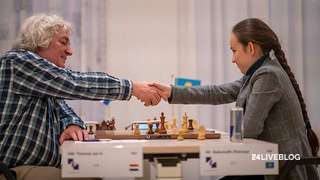
    So this match still isn’t decided yet!

    Firouzja resigns

     
    Incredible finish

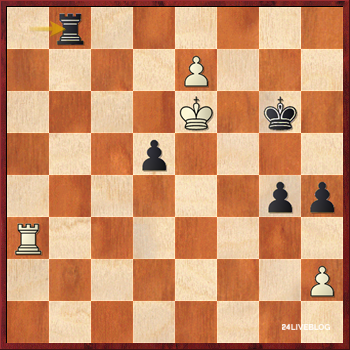
    It was quite incredible the way Jan Timman won the fourth game against Zhansaya Abdumalik.

    Timman-Abdumalik

    Why did the Kazakh player played the ‘mysterious rook move’ 42…Ra8 ? Well, she had seen the following 5 moves, but…

    ‘I didn’t see his move 48.Ra4,’ Zhansaya said. ‘Otherwise 48…g3 probably draws.’ After that the Dutch GM brought a very elegant zugzwang position on the board.
    Abdumalik thought that, instead of 42…Ra8 (see first diagram), 42…Kf6 or 42…Kf7 would lose to 43.Kxd6 followed by 44.Rf2, but Black can play 43…Ra8 when her rook is on the long side, with a draw even if all the other pawns are off.

    So we see that even on this level rook endgames are still very, very difficult.

    Abdumalik resigns

     
    Pruijssers wins

    Roeland Pruijssers finally hauled in the point after a long struggle with Menno Okkes (who had prepared the piece sac line that came on the board!), and thought he had qualified for the semi-finals. Alas, chief arbiter Frans Peeters had to disappoint him: it is Viktoriia Kirchei who is placed 4th on TPR.

     
    Timman and Cori win; Sindarov, Werle, Ernst and Kirchei to semi-finals

    Another spectacular round in the matches today. Alireza Firouzja, who was leading 3-0 against Jorge Cori Tello, played too optimistically with his pieces. This time Cori reacted very calmly and carefully, and cashed in a pawn, but only when Firouzja blundered the game was really finished. Zhansaya Abdumalik went wrong in a tricky rook ending against Jan Timman and lost. Thus, the Dutchman took the lead for the first time in the match.

    In the Open, Jan Werle and Javokhir Sindarov drew very quickly and thereby qualified for the sem-finals. Sipke Ernst did the same with a draw from a superior position against Italian GM Pier Luigi Basso. To the surprise of many, 14-year-old Russian girl Viktoriia Kirchei qualified with a victory over Thomas Beerdsen. She had just a tiny edge on Roeland Pruijssers according to their rating performance.

  • Chess stars take a look deep into space

    Chess stars take a look deep into space

    The four match players of Hoogeveen Chess – Alireza Firouzja, Jorge Cori Tello, Zhansaya Abdumalik and Jan Timman, plus Geertje Timman and Ivette Ale Garcia Morales, Jorge Cori’s girlfriend, had a highly interesting afternoon on their free day. They paid a visit to the Netherlands Institute for Radio Astronomy ASTRON. Here, in Dwingeloo, just about 15 kilometers from Hoogeveen, intensive scientific research and development is being done on world top level. The high point of the afternoon was a visit to the Dwingeloo Telescope which dates from 1956.
     
    First the institute’s manager Gert Kruithof informed the company about the different measuring devices that have been developed at ASTRON. The Dwingeloo Telescope used a single dish which was, for instance, the first to discover that the Milky Way has a spiral shape. In 1970, 14 dishes in a row were built in nearby Westerbork. All these dishes are pointing in one direction and are constantly moved together in the same direction.
     
    ‘We have found all kinds of “weird objects”,’ Kruithof explained. ‘Like black holes and neutron stars. The universe is very absurd.’ Thanks to a recent upgrade of the receivers of the Westerbork telescope, it can scan a 40 times larger area of the sky at once than with the previous receivers. This enables ASTRON to scan the sky faster. In 2010, ASTRON also opened a new telescope called LOFAR (= Low Frequency Array); a field of antennas consisting of a pole with four wires, which can be very easily pointed to a source in the sky, using software.

     
    The amount of data collected by the Institute is so huge that they develop their own technology for it, with the help of several industrial partners. An inconceivable amount of discoveries have been made here in Dwingeloo. For example, WiFi was discovered thanks to a research project that had been started by the Dutchmen Johan Hamaker and Jan Noordam and the Australian John O’Sullivan to find ‘small black holes’, the existence of which had been suggested by Stephen Hawking. The black holes weren’t found, but in the end the mathematics used to find them gave us WiFi. And the technology to collect big data can also be used in, for instance, medical science.
     
    Hungarian astronomer Zsolt Paragi took the company to a correlation centre hosted by the Joint Institute for VLBI ERIC (JIVE), where big data from telescopes all around the world are collected in a super-computer. This big computer produces so much heat that the room in which it is placed has to be cooled, using a lot of energy. The chess company enjoyed a real ‘science-fiction’ sensation when Zsolt turned the lights off in that small room with the ‘correlator’ blazing and all kinds of lights flashing. ‘You can solve the Najdorf here,’ photographer Lennart Ootes whispered to Zhansaya Abdumalik.
     
    Italian scientist Pietro Zucca explained the workings of the LOFAR antennas in the control room. He told the group that the data are stored in long-term archives in the Netherlands, Poland and Germany. The magnetic tapes that hold the data have no copies, because that would be too expensive.
     
    King Willem-Alexander and Queen Maxima of the Netherlands recently visited ASTRON, but they were only there for 25 minutes – the chess players had more than an hour!
     
    After the guided tour through the Institute, the great radio-telescope from 1956 was visited. Inside the telescope, volunteer Tammo Jan Dijkema started turning the colossus (40 tons of steel) ‘like a very slow merry-go-round’ towards the spiral arms of the Milky Way and after that to a pulsar (a neutron star which had collapsed into a ball measuring 20 km across but equally heavy as our own sun – one teaspoon weighs as much as the entire Mount Everest) at about 3000 light-years distance. The pulsar turns and emits radio light, which is observed on earth and converted into pulses. This ‘heartbeat of a dead star’ was disturbed by a loud second noise when somebody in the company turned on his mobile phone – a nice demonstration of what can happen!

     
    The players and the tournament director received an ordner with information about the Institute, and a nice futuristic tool pen from ASTRON. After some pictures had been taken in front of the telescope, this extremely interesting excursion was concluded. It’s hardly credible that such an institute, the top three of the world in importance which produces such fascinating results, is ‘hidden away’ near the pretty National Park Dwingelderveld, and so few people know about it.
     
  • 10 players in contention for the playoffs

    10 players in contention for the playoffs

    Live blog by Peter Boel

    Blog will start late in the afternoon

    This afternoon we are visiting the National Astronomic Institute and the Dwingeloo Telescope with the four match players, who are having a free day. This means there will be no live-blogging until late in the afternoon, when we intend to make a round-up of the most important developments in the Open group.


    Basso wins

    We’re back from a wonderful trip to ASTRON in Dwingeloo! Re-starting the blog, the first important result we can mention is that Pier Luigi Basso has just beaten Harmen Jonkman. There was a weird pawn constellation on the b-file (two sets of doubled pawns!) and Basso won a pawn with a petit combinaison. In a tricky position he managed to hold onto it and win.

     
    Fascinating game on board 1

    In front of a big crowd, Javokhir Sindarov and Sipke Ernst are playing a fascinating game on board 1. Ernst has put some big guns on the b-file, but Sindarov countered with an attck on the exposed black king. On move 30 he missed (or rejected?) 30.Rd3 after which he would have been an exchange up, and one move later he should perhaps have gone for the slightly worse ending after 31.Rdxe7 etc. After 31.Rxc7? Ernst could preserve his bishop and organize his defence.

     
    Yes, it’s a draw

    You wouldn’t believe it but Board 1 has ended in a draw. ‘White has a fortress,’ Sipke Ernst said. ‘I looked at the position for maybe 5 minutes and saw no way to get through. The engine of course says it’s winning for Black but it doesn’t give any winning plan. I would need one more pawn to break through, say on h6, and even then it would have been difficult.’ Sindarov offered the draw, which indicates that he was fully aware of the fortress idea.

    Earlier on…

    Ernst had missed 30.Rd3. ‘I looked at 30.Rb1 and saw that 30…Qb5 then holds.’ (because Rd3 is not possible now) ‘This is quite nasty…’

     
    Werle spoils the win

    It looks like Jan Werle has spoiled the win this time after another strong performance. His time-trouble move 39.Rg3? gave Black the chance to organize his defence by moving the king back to g7 and putting his queen on d4 just in time.

     
    Kirchei and Ganesan also heading for a draw?

    Kirchei also played a very good game all afternoon, but she probably went wrong on move 32. She went for the wrong pawn with 32.Rgg6!? whereas 32.Rf6! would have made Black’s defence still difficult because the Rg7 can take the b-pawn later. For some reason the engine gives 32.Kg2 and only then 33.Rf6 as even better.

     
    Wins for Okkes, Doshi and Schoppen

    Menno Okkes survived a Sicilian sacrifice against the young Norwegian Tor Fredrik Kaasen and converted the extra piece in the endgame to a point. Moksh Amit Doshi took one of Nichita Morozov’s pawns that had strayed too far and converted that in a knight ending. Casper Schoppen came back from two tough defeats with a breakthrough in a complicated French Defence against Herman Grooten.

     
    Pruijssers heads for a win

    Nikhil Dixit has been playing quite well but he is about to get busted in the endgame now by Roeland Pruijssers. Dixit has now sacrificed his knight but normally that shouldn’t help.

     
    Draw for Kirchei, Pruijssers wins

    Fourteen-year-old Viktoriia Kirchei didn’t do any crazy things after her missed win, and drew against Akash Ganesan. She realized that perhaps she had missed a win somewhere, but ‘I’m happy with the draw.’

    Dixit has indeed resigned against Pruijssers.

     
    Vrolijk in trouble…?!

    Liam Vrolijk is not having a cheerful tournament so far. He gained 3 points for the ‘small exchange’ against Jonas Hilwerda, but then played a few too tame moves and now suddenly his king is threatened with a mating net!

     
    Hilwerda wins

    Jonas Hilwerda (16) could hardly believe his luck after his win against Liam Vrolijk: ‘Actually all I could do was play my king from e7 to e8 and vice versa. I think his 57.b3 was bad – I could exchange pawns and enter the a-file with my rook.’ Actually Vrolijk may not have been doing that well in that position anyway, since Black had the possibility to play …Rd7.

     
    10 players still in the running for playoffs

    After six rounds, ten participants still have a chance to qualify for the four-player playoff that starts after round 7. On board 1 today, Javokhir Sindarov and Sipke Ernst played a fascinating game which ended in a draw although Ernst was a rook up against two pawns. It turned out that the young Uzbek had a fortress. On board 2 and 3, Jan Werle and Viktoriia Kirchei missed wins against Thomas Beerdsen and Akash Ganesan respectively.

    As a result, no less than seven players are now on 4.5 points. Sindarov has 5.5, Ernst and Werle 5. Werle is playing Sindarov tomorrow, and Ernst faces Italian GM Pier Luigi Basso, who is one of the seven contenders.